I got invited to talk about my experiences with the Internet Thought Police on the Dale Jackson show in Huntsville this morning. Here it is for your listening delectation:
Wow, that’s the most hits this blog has ever gotten. Hope you’re all enjoying my content. Plenty of stuff for y’all to get angry about, I imagine.
Not that it is likely to matter, but I would like to clarify one point as clearly as humanly possible. The intention of my tweets last night was to point out how reckless it is to throw around wild accusations of white supremacy toward people who are not white supremacists. It was most definitely not to defend or excuse white nationalism. I was not attempting to defend Jared Taylor; I was insulting Rashida Tlaib by saying she was worse than he was.
Now that that’s cleared up, welcome to my blog. There’s plenty for everybody.
So after contemplating it for several months, I decided to deactivate my Twitter account. I’ve been 8 years or so on there, and over that time it’s slowly changed from a useful networking tool to a soul-crushing hellscape that was poisoning my real-life interactions with people, so I had to let it go. I’m writing this blog post for anybody that wonders where I went.
The proximal cause for my decampment was a series of four political shitpost tweets I sent out the evening of Aug 6. The tweets were motivated by a rash of news reports of prominent Democrats unironically accusing President Trump of being a “white nationalist”, and taking the position that his supporters (with whom I proudly count myself) represent a “white nationalist” movement that supports terrorism against “people of color”. This concept struck me as so over-the-top and irresponsible, and so dangerous coming from such prominent, powerful people, that I felt I really needed to say something. Unwise, certainly, but I honestly couldn’t stand silent while that kind of bullshit attack was being lobbed at people I care deeply about. Below I’ll talk about the tweets, and I stand by each of them, but it occurred to me even as the hate responses started coming in that it was pointless to try to defend them since the responders are True Believers that the President is an Evil Naughty Person, so I left the field of battle before getting dragged into some big thing. Sure, I ran away — but not just from this fight, but from all the other ones I knew were coming between now and November 2020 as the US tears itself apart again like it did starting in the summer of 2015. I just have no interest in suffering through the next year and a half on that garbage platform; I have plenty of better things to do with my time.
Since I deleted my Twitter, I don’t have the exact text of the tweets, but I can reconstruct them pretty faithfully. Let’s have a look:
TWEET 1: “The idea that ethnonationalism is intrinsically hateful or terroristic is just ignorant. It’s probably the most common form of social organization on Earth.”
This is self-evidently true. Something like what we call ethnonationalism today was probably the ONLY system of social order through most of human history, and is still the dominant political force in a lot of pretty stable countries. It’s more of an emotion than a coherent ideology, and it naturally emerges from the affection one feels toward close kin and the familiar comforts of home and hometown. The evils of the colonial period created situations that disrupted that organic unity, but arguably it was ethnonationalism that helped preserve many unique cultures as their countries were settled by foreigners. Ethnonationalist ideas are hugely varied, ranging from completely biological ideas of who gets to be part of a state (e.g., ancestry requirements to be a part of Native American tribes) to completely social ideas of who gets in (e.g. Israel, or the multi-racial civic nationalism espoused by Trump). They also run from the open and pluralistic (again, Israel and the US) to the sealed-off and totalitarian (e.g. Nazi Germany, North Korea).
The important point here, though, is that there is literally no reason to expect that a person who understands their country to have an ethnic basis, would therefore “hate” people of other ethnicities, or would support using terror or violence against people of other ethnicities. Sure, they might, but people have hateful or violent attitudes for all sorts of other reasons as well. Ethnonationalism, including when it is practiced by various kinds of “white people” (whatever that means), is not synonymous with hatred or terror.
Which bring us to…
TWEET 2: “Let’s be honest: “White Nationalist” is just a racist slur used to incite hatred and violence toward people because of the color of their skin.”
There are actual “White Nationalists” in the world that fit the definition commonly understood by the left: people who believe in the creation of a “white”-only ethnostate of some kind. These people are rare, and run the gamut from calm studious types who disavow violence (see below) to Nazi prison gangs that sell drugs and kill people for fun. People who advocate for a “white” ethnostate are rare, however, and the dangerous latter type are despised by nearly everybody (including other “White Nationalists”).
But in the news, we have Very Important People claiming that the 50,000,000 Americans who voted for Trump, or at least a large fraction of them, are White Nationalists. Most of these people (including me) would laugh at the ridiculousness of forming a “white”-only state. Indeed, both Trump and his media supporters bend over backwards to elevate “people of color” who support Trump, and these are not insignificant in number. Sure, some of this pandering is super cringy, but it’s still really odd behavior for people who want to build a white ethnostate. No, there’s no reasonable way you can claim that a large number of Trump’s supporters are true-blue White Nationalists.
So why do those Very Important People say such things? Simple. It scares people, and scared people vote. If they can hoodoo enough “people of color” into believing that Donald Trump and the Russians are going to try to put them into concentration camps, they will show up in droves to vote him out of office. Never mind that it’s completely fatuous to draw a line connecting “civic nationalism that is concerned about unchecked immigration” with “violent psychopaths that want to kill Mexicans”, it’s still a brilliant campaign strategy, especially if you own enough media outlets to completely saturate the airwaves with your propaganda.
That’s dirty politics, which is of course business as usual in any democracy. But the problem you can’t get past is that concentration camps aren’t something you can just overlook, or take your chances at the ballot box about. Let’s be clear — if you genuinely believe that millions of your countrymen want you dead, how can you not support violence against them? What kind of coward, believing that the government was planning to exterminate his neighbors, wouldn’t take up arms to stop them? Especially in a country where you can just skedaddle down to the local gun shop and buy a semi-automatic assault rifle for $500. You want to talk about dog whistles?? Calling the President a White Nationalist is a straight-up dog whistle to every antisocial leftist nut in the country that it’s time to start shooting. It’s an open call for civil war, for no reason except to win elections.
TWEET 3: “Anyone who believes that mild-mannered scholar Jared Taylor is a hate-filled terrorist but Rashida Tlaib is an ambassador of love and tolerance is literally insane.”
And that brings us to “civility”, a concept the left despises, and why it’s so important. These two people are in some ways very different — Jared Taylor is a White Nationalist pariah, Rashida Tlaib is a left-wing icon and congresswoman. But they also have a lot in common, in that they are both racists who share a cartoon understanding of “white people” that they use to explain how our society works. Both seem to agree that “white people” and “people of color” can’t peacefully coexist under the current order, and would be better off either separated, or with one of those groups presiding over the other. It’s all very dumb, since both “white people” and “people of color” are comprised of dozens of different ethnicities with radically different histories, social networks, and modern interests, such that imagining that they represent coherent political groups is completely silly. But nevertheless, that’s how these guys think.
The reason I bring them up is that they clearly flip the concept of “hate” on its head. Taylor is this old professor dude who writes calm, philosophical pieces on his beliefs about social organization and the history and future of humanity. I’m no Taylor expert, but from the couple of pieces I’ve read and his Wikipedia article, there’s no indication that he has EVER advocated violence, or expressed any emotion toward “people of color” that could be viewed as “hateful” without really butchering the common understanding of that word. Leftists reject Taylor’s civility by insisting that there’s no way to form an ethnostate without massive violence — and while that MIGHT be true, Taylor doesn’t seem to believe so, and goes to great lengths to disavow violence and support voluntary separation of “white people” and “people of color”. Let me be clear, I deeply disagree with Taylor’s vision for the ideal future of the United States, but there is simply no reasonable way that one could see this genuine White Nationalist as a terrorist.
On the other hand, Tlaib is a wild-eyed demagogue that doesn’t shy away from using incendiary, racially-charged language to whip up crowds. While she ostensibly represents “diversity” and “tolerance” and the other virtues of “Wokianity”, she is clearly motivated by a visceral hatred of conservative “white people”. I mean, you can see it on her face — scorn, contempt. She sees us as vermin, “White Nationalist terrorists”, lumping millions of people together into a single sub-human, disposable class, based purely on the conditions of our birth and the color of our skin. And she know she’s using words that flame that hatred in others — she obviously chooses them for that effect. If you’re looking for a Hitler analogue, there you go — an angry ranting demagogue who gleefully blames all the world’s problems on a single hated ethnicity.
Again, let me be crystal clear, I don’t agree with either of these people. I’m a civic nationalist who believes the US has a traditional ethnic character comprised of multiple distinct ethnic groups, whose uniqueness should be preserved by limiting immigration. Both Taylor and Tlaib believe things that would threaten that traditional nation. But there’s only one of them that I believe would support using violence and terror to achieve their stated goals, and it ain’t the “White Nationalist”.
(As an aside, it’s maybe worth noting that one of those two people is also a rabid anti-Semite, and it’s not the one you’d expect…)
TWEET 4: “But if you want to sign up with a hateful mob and attack people like me because we were born with the wrong color skin, at least have the common decency not to ask me why I feel the need to own a gun or twelve.”
And this is where it ends, and it’s pretty much how Twitter makes me feel. Over the last 6 years I feel like I’ve watched the country fall apart, and now we’re teetering on the edge of civil war, with one party in our country convinced that the other is comprised of Nazis led by Russian secret agents. If they believe that, how could they not want to use violence against us? And how could I not want to protect myself and my family as best I can? It’s not the world I would choose, but it’s the one we apparently have.
So what I try to tell myself, though, is that Twitter isn’t the real world. In the real world, I know few people who believe any of this crazy bullshit. I can talk about politics with people on the left without getting into shouting matches or even feeling like we were fighting after we’re done. I have friends and colleagues from many countries, with many varied beliefs and colors and interests. Even those colleagues who I see on Twitter RTing hateful political shit from leftist pundits, are pleasant enough in person, and it’s hard for me to believe they think I’m a White Nationalist or a Russian Stooge. Maybe they do, and they’re just being polite, but fuck, why can’t they be polite online too?
So Twitter isn’t real life, and Twitter makes me angry against real life people and probably makes many real life people angry toward me. I used to have meaningful interactions with scientists on there, but most of that has ebbed away over the years, leaving nothing behind but sports news and angry politics. So I’m gone. For that matter I also deleted my Facebook account. I’m actually completely free of social media at this point.
Just a reminder, I’m still a real-life person, and you can get in touch with me the old-fashioned way, via email or even a phone call. I know you’ll miss my paper retweets and opinions on heavy metal music, but you’ll live.
A lot of people are apparently convinced that climate change is responsible for Hurricanes Harvey and Irma. These destructive storms are conspicuous and terrifying, and therefore they provide an easily visible and emotionally powerful centerpiece for political arguments about the need to curtail fossil fuel emissions. Only problem is that the data connecting storms to climate change is sketchy at best.
I’m not going to go into the output of real climate scientists here. My understanding is that the prediction that the future will hold more and stronger tropical storms is based on models, much like predictions about the future of Earth’s temperature. These models are based on a combination of historical observation and theory about the underlying causes of weather patterns. Models are very useful for these sorts of things — but I’m often miffed at how science reporters fail to convey to the general public the limitations of models, or give an honest representation of the “error bars” on future predictions. Regardless, doesn’t matter, in this blog I’m not going to talk about the models at all.
Also, I want to preface this by saying that I don’t consider myself to be a climate change skeptic. Number one, I’m a scientist that works on questions involving anthropogenic global change. Moreover, I believe humans are changing the composition of Earth’s atmosphere and that those changes appear to be causing the planet to warm at some rate. I agree with most other scientists that for that reason, and a host of others, humans need to figure out another way than fossil fuels to provide for their energy requirements.
But also as a scientist, I get angry when people misrepresent facts and overstate conclusions. The argument that storms will get stronger in a warming world makes theoretical sense, but the problem is that it isn’t clear i) that it’s actually happening or ii) if it is, how much of an effect it actually has. For instance, Hurricane Irma has record-breaking wind speeds of 185 mph. How much of that, if any, is due to forming over warmer oceans? If Irma had formed in 1990, would she have had 181 mph winds? 150 mph winds? Would she not have formed at all? These possible effects of climate change run from the insignificant to the apocalyptic, and all seem plausible to me at first glance. Moreover, hurricanes are relatively infrequent, so my gut-level intuition as a scientist who works with real datasets is that we can’t come to any conclusions about the effects of climate change on storms unless those effects are quite large.
Fortunately, the internet has lots of data, so it’s pretty easy for a concerned citizen to go download some pretty good numbers to do some back-of-the-envelope calculations for a first pass at assessing these claims about climate change and tropical storm intensity, which is just what I did. I whole-heartedly encourage all of you to do the same about this and any other controversial political claims — don’t just rely on the prognostications of Internet Science Guys, pull the numbers yourself. The analysis I’m going to talk about here took me less than half an hour to do.
First, let’s consider the hypothesis that storms are becoming more frequent with time. I pulled data for Atlantic tropical storm frequency from 1851 to 2015 from the awesome website WeatherUnderground.com. Per year, it lists number of total tropical cyclones, the number that eventually became hurricanes, and the number of deaths reported.
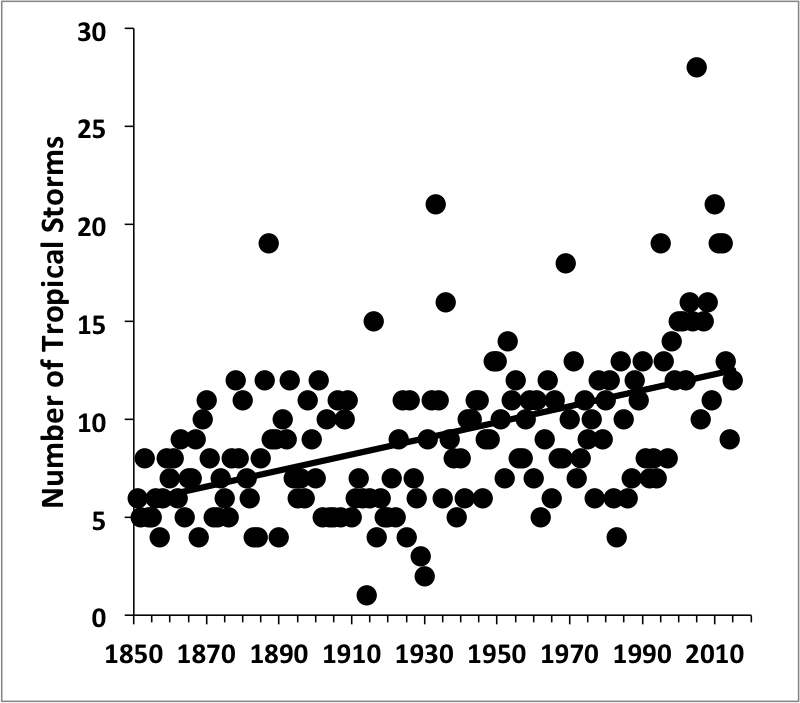 Figure 1
By doing a simple linear regression (figure 1), we see that the number of storms has significantly increased (p << 0.001) over this time period, by about 0.04 storms per year each year.
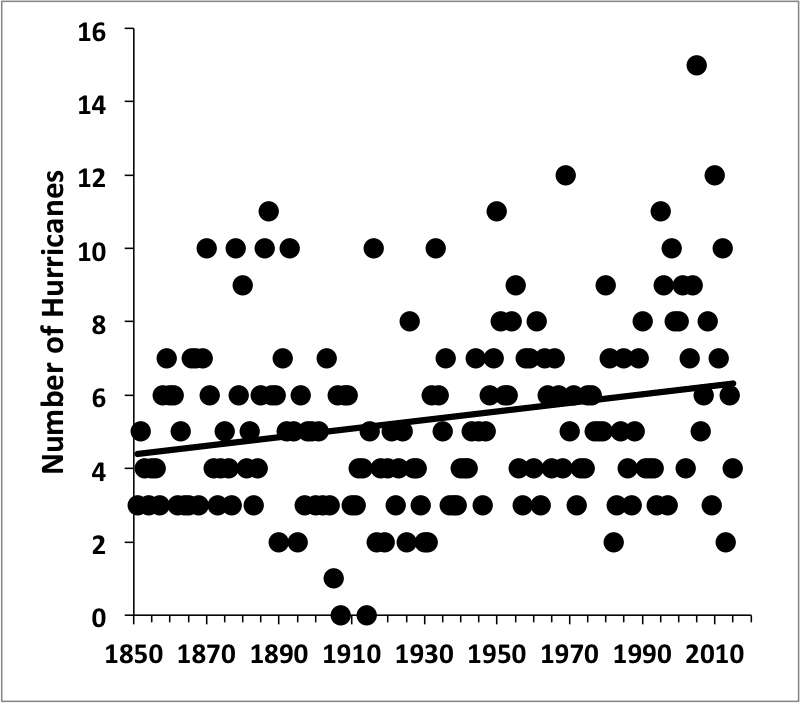 Figure 2
The number of hurricanes has also increased (figure 2, p = 0.004) but by a lesser amount of 0.01 hurricanes per year, per year. This seemed odd to me — if rising temperatures are creating storms, wouldn’t we expect a similar increase in both types of storms?
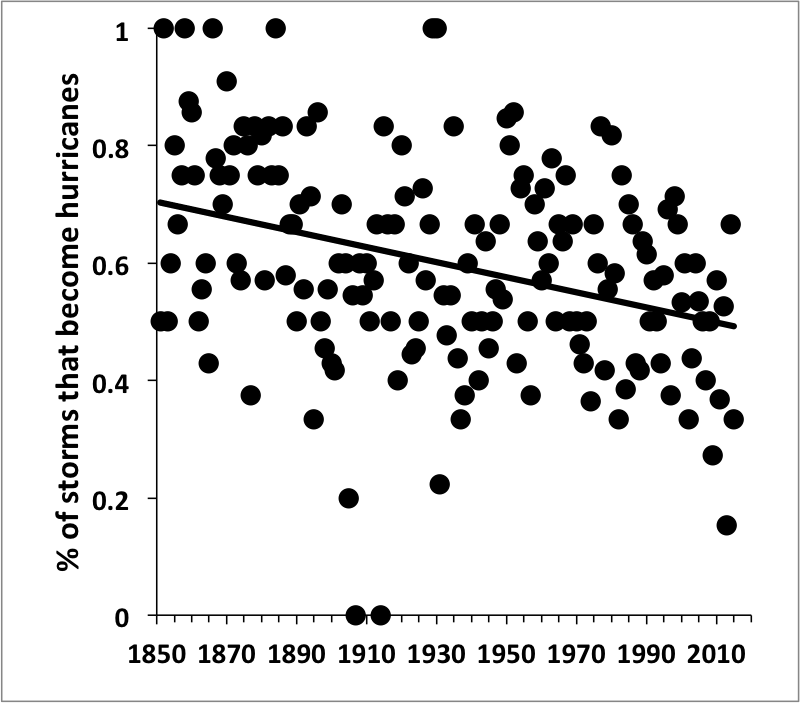 Figure 3
So I looked at the change in the percentage of tropical storms that became hurricanes eventually (figure 3), and discovered that this value actually significantly DECREASED (p << 0.001) by 0.13% per year over the time frame considered.
These observations may support the idea that climate change is increasing storm frequency, but it contradicts the idea that it’s making storms worse. Another, more likely possibility is that storms aren’t actually becoming more frequent or milder, but that our technology for detecting them is just improving, meaning that storm frequency for the earlier years in the dataset was underreported, and was biased toward large storms (hence in some earlier years 100% of reported storms became hurricanes). To test this, I constrained my analysis to just the “satellite era” when we gained the ability to see storms from space even if no one was around to experience them. This technically started in the 1960’s, but I used a relatively arbitrary cut-off of 1976 to give the technology some time to come into routine use. With this limited dataset, we still see storms in general increasing significantly (p < 0.001) at the even faster rate of 0.22 storms per year per year, but hurricanes no longer increase significantly, and the decrease in the percentage of storms becoming hurricanes becomes even more pronounced (-0.005% per year, p = 0.01). I feel this tentatively supports the hypothesis that the appearance of increasing storm frequency is an artifact of increasingly sophisticated and careful reporting; but regardless, it fails to support the hypothesis that climate change is producing stronger storms, even if it may be favoring a greater number of less powerful ones.
I wasn’t able to find easily mineable data for top wind speed or lowest barometric pressure for historical storms, but another metric we can use to estimate storm intensity is the loss of human life. It’s relatively easy to lose track of simple tropical storms, harder to ignore hurricanes, but it’s really hard to ignore dead bodies. So I ran a regression analysis of number of deaths from tropical storms per annum from 1851 to 2016, and discovered there was no significant increase in the lethality of storms during this time period, nor was there a difference when the analysis was run just using the 1976-2015 data. But this understates the case. When I normalized deaths against the US census for the population size of the state of Florida across the same time period (hopefully a reasonable proxy for general population increase over the same time frame), we see that the risk of death by tropical storm DECREASES significantly (figure 4, p = 0.001) by about 0.013% per year over this time period.
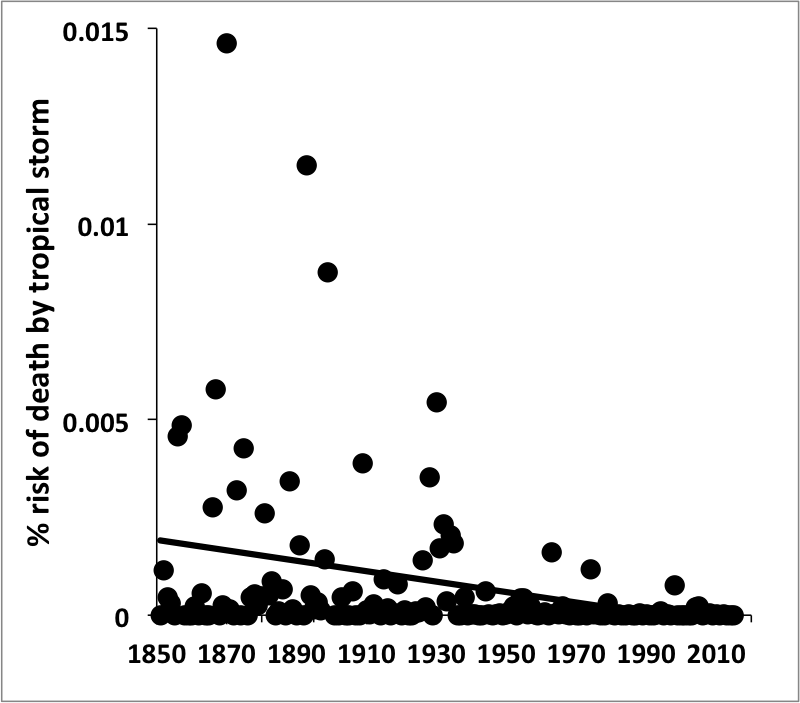 Figure 4
This isn’t surprising, since our ability to predict landfall and prepare for its effects have surely increased dramatically since 1851. For instance, in 1870, you had a ~1.5% chance of being killed by a hurricane, the equivalent of Irma killing 250,000 Floridians today! However, when we just consider 1976-2015, we still don’t see an increase in risk of death by hurricane, despite the fact that we know that large storms like Katrina are still capable of killing many people despite our best preparations. Thus, the hypothesis that storms are becoming more lethal is soundly refuted by this simple analysis.
I’m sure there are much more sophisticated data analysts out there, and accept that they might be able to come up with superior analyses to the very simple one I’ve done here. However, I think it’s important to look at this, because the reality is that the assertion that climate change is affecting hurricanes, and that the deaths in Houston and the Caribbean this year can be put on President Trump’s bill, really doesn’t pass the first smell test. There is ample reason to be skeptical of these claims, and they aren’t based on ignorance or climate myopia.
Not too long ago I wrote about the silliness of all the hysteria surrounding the smidgen of ebola cases entering the United States. Of course, ebola’s gone from the news cycle (though Africans are still dying by the thousands, concerned Americans), but now hysteria has raised its ugly head again with the measles outbreak in California. A few dozens have been infected, all a lovely gift from Disneyland and the anti-vaccination fad.
Of course, everybody is looking for somebody to blame. The majority (all?) of the people who got sick were unvaccinated, as is the case in every measles outbreak for obvious reasons. Therefore, it’s those goddamn antivaxxers making everybody sick, right? It’s irrational child abuse not to vaccinate your kids, so let’s force them all to get their measles shots. Or maybe it’s the goddamn Mexicans, bringing their filthy third world diseases illegally across the Rio Grande. Let’s close the borders.
Whoa, pardner. First of all, those dirty foreigners apparently have higher vaccination rates than Americans. Second of all, before we go railing about how irrational the antivaxxers are, maybe we should step back and take a second look at that question.
Vaccination is a classic case of a Public Goods game. Vaccination obviously greatly reduces the risk of getting sick, and it also provides “herd immunity” — the more people around you have been vaccinated, the more protected you are even if you haven’t been vaccinated. There’s obviously a cost associated with being sick (as in you could possibly die), so it’s good to not get sick. But, as the antivaxxers remind us, there is also a potential cost to getting a vaccine, in that you might suffer a side-effect, also possibly killing you. Because of herd immunity, the benefits of vaccination are shared by the community, including the unvaccinated people who don’t accept the costs of vaccination.
Why it interests me is that there’s a clear partitioning of the benefit of vaccination between a private component — the near-complete immunity of vaccinated people to the disease — and the public component, the lower risk of being infected in a population containing many vaccinated people. Public goods that have that partitioning are what we call Black Queen functions, and they have the interesting property that they allow co-existence between “helpers” (in this case, vaccinated people) and “cheaters” (antivaxxers). In other words, it makes rational sense for a certain number of people to remain unvaccinated in society.
We can use some math to figure out what that number is. Now, let me preface this by saying I’m neither a mathematician nor an epidemiologist, so if this is all over-simplified or algebraically wrong, I apologize. I’ve definitely made a lot of simplifying assumptions for mathematical tractability. But here goes. Let’s define a system as containing three groups of people: iMmune people (M) who have been vaccinated and can’t get sick, Anti-vaxxers (A) who haven’t been vaccinated and can get sick, and iNfected people (N) who are currently sick. The whole population of people is thus P = M+A+N.
The population as a whole grows and shrinks by normal birth and death, with death being a constant function d of the current population size for each group, and births occurring at a certain maximum rate b that drops to 0 at a rate controlled by a constant, k. M‘s and A‘s grow and die at the same rate and always reproduce their own type. Absent disease, we can describe the normal disease-free growth of the population as a differential equation:
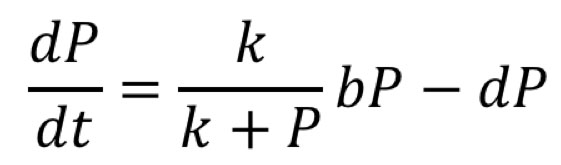
Now let’s add in the expectations of the Black Queen evolutionary system. First of all, there’s a cost to vaccination. Some number of M‘s will suffer severe consequences from vaccination, resulting either in death or an inability to reproduce. Let’s say this takes place at rate s; then we can describe the dynamics of M with:

Importantly, M‘s never get sick. A‘s, on the other hand, get sick at a rate determined by an infection constant i and the number of infected people — N‘s — in the community. N‘s on the other hand, either get better at rate r (thus reverting to A’s) or they die at rate m. Now we can describe the dynamics of A‘s and N‘s:


Lots of things can happen inside a model like this, but we’re only going to concern ourselves with its equilibrium point — or where everything stabilizes and quits moving around. We do that by setting the “dX/dt” side of the equations — the differential, which describes movement — to 0 and solving for the three variables representing our population members. If we assume that all the N‘s get over their illness reasonably quickly (relative to the long-term birth/death process of the population), we can say that r+m=1. Thus, the total of antivaxxers and infected people in the population at equilibrium becomes:

Okay, let’s break this down. This equation describes the number of antivaxxers we expect if everybody is acting rationally — it balances the costs of infection with the costs of immunization exactly. This number is largely controlled by the danger associated with the vaccine — s, which makes the number go up — and i, or how infectious the disease is, which makes the number go down. To put it in human terms, it makes sense not to get the vaccine if you see more people having side effects to the vaccine than you see people getting sick with measles.
(Note that this is a generic problem with preventive measures: if they work, it starts to seem like they’re useless, because the thing they prevent becomes so rare as to seem inconsequential. A very similar argument could be made about the value of individually-owned firearms to society: nobody in Somalia would argue about the value of owning a rifle, but in whitebread suburbia — suffused with armed cops lurking in the wings — guns seem superfluous.)
Let’s plug in some real numbers. As best I can tell, the probability of having a severe side effect from the measles vaccine is about 1 in a million, but let’s go crazy nuts and say it’s 100 times that high, and 1 in 10,000 people who get immunized are either killed or sterilized by the measles shot. Since you only need one shot in a whole lifetime (let’s call that 50 years), the rate constant s works out to 0.000002 per year. The death rate for people infected with measles is also quite low — roughly 2 in 1000 in the developed world — so m = 0.002. Finally, the infection rate is very high, so let’s set i = 0.95, representing a 95% chance of getting sick if you’re surrounded by sick people. With these values, the total number of antivaxxers and infected people supported by the system is: 1 per square mile. In fact, assuming s is very small, the abundance of antivaxxers reduces to 1/i, entirely dictated by the likelihood of being infected when you encounter a sick person.
Interestingly, this value doesn’t change if we raise or lower the total population size, although we can calculate how population size affects the proportion of the infection pool to the total population. The algebra is a little hairier but eventually you get:
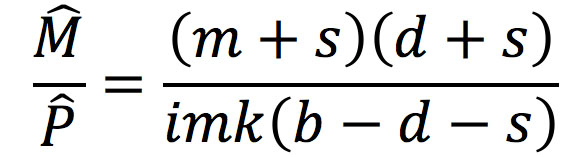
So, the proportion of cheaters goes down as k (i.e. population size) goes up — meaning it’s more likely you’ll see the use of vaccinations when you’re in a big city with lots of people than out in the country by yourself. Makes sense, no? If we plug some numbers into this equation — b = 0.003 per month, d = 0.0007 per month, and k= 1000 people per square mile — we arrive at an equilibrium proportion of cheaters of about 0.03%. In the United States, that would work out to about 90,000 people.
We’re clearly not at this equilibrium point now — there are way more antivaxxers than that. It’s possible that right now, the number of N‘s is so low and health care is so effective at isolating illness (lowering i) that it’s really hard to get sick. Presumably, if the antivaxxer fad continues, the prevalence of measles will increase until more and more A‘s get sick, eventually causing their numbers to start to drop towards a stable equilibrium.
I know people like to attribute “insanity” to movements like antivaccination. However, I suspect that antivaxxers (and other conspiracy theorists) are normally rational people with mistaken beliefs. When confronted with obvious evidence in the form of sick antivaxxers, they’ll change their tune. But regardless, the equations suggest that the risk even to them is low, and to those of us who are vaccinated, the risk is extremely, vanishingly low.
We COULD force the antivaxxers to get shots. This would save a very very small number of lives. It would also cost a fortune and would involve using force to shoot drugs into people, which seems exceedingly creepy to me. Before I’m willing to sign on to a policy like that, you’ll have to show me a disease with a much higher m than measles. Till then, there are more important things to spend our money fighting.
Dear readers: if you’re enjoying reading my rants, consider sharing or re-tweeting! ASD needs more cultists.

 The Antisocial Darwinist