The Antisocial Darwinist

Black sheep science from the Right side of campus. Plus music reviews.

  • About the Author
  • Contact Me
  • Music Reviews

The Non-Problem of Creationism

Posted by Jeff Morris on November 1, 2014
Posted in: Evolution, Politics, Religion. Tagged: Creationism, Michigan State University, MSU, origin summit. Leave a comment

The Creationists are coming! The Creationists are coming!

A gang of actual Young Earth Creationists has managed to organize a day of seminars today (November 1) at Michigan State University. These wingnuts, who believe our planet is less than 10,000 years old, have been given crap tons of press by outlets as prominent as Science magazine, one of the big 3 prestige journals (thanks, guys). It’s no coincidence that MSU was picked — it’s a nexus for evolutionary biology in the US, home both to the BEACON Center for the Study of Evolution in Action and the famous Lenski Long-Term E. coli Evolution Experiment.

One might suspect that the Christers are attempting a classic troll of MSU biologists. You would think that Internet-savvy millenial graduate students would be able to spot it a mile away, shake their heads, and move along. I mean, these guys know not to read Internet comments, right?

But no… some of them are apparently organizing some kind of response. HOW DARE someone not accept the SACRED DATA! To the barricades!

Our academic holy crusaders always have to fight something, whether it’s implicit biases, IQ tests, criminally insensitive health insurance, or now the Young Earthers. Here’s a list of reasons why they should stay out of this one:

1) YOU DON’T HAVE TO FIGHT EVERY BAD GUY.

There are lots of annoying, self-righteous, cruel, wrong, etc. people in the world. Many of them would love to change the system in generally problematic ways. Some of those people actually have the power to do the horrible shit they want, and yes, we should fight people like that. Other people, though, are paper tigers — they talk a big game, but ultimately don’t have the capacity to change much of anything.

The Creationists — particularly these Young-Earthers — are of the latter variety. They bluster, posture, and circumlocute. But their bizarre beliefs don’t have much impact in the real world! When they manage to organize a publicity stunt like the one at MSU, it’s a major success for them. Probably the worst thing these types have managed, in decades of effort, is putting some stupid sticker in the front of high school biology textbooks. Guys, these small successes represent the extent of the Creationists’ power, the result of massive expenditures and years of cajoling.

We are strong; they are weak. By fighting them, we suggest to the world that we are afraid of them, which elevates them — at least in the public view — to parity with us. It makes them look stronger, viable, and certainly must help them attract recruits. Fighting an enemy like that — one that is orders of magnitude weaker — is literally counter-productive, since it strengthens the enemy! Sending the weight of academic evolutionary biology to crush the Creationist bug would be as ridiculous as sending the entire US military to destroy a small cadre of religious gangsters on the other side of the world.

Please tell me you’re smarter than this, scientists. Stay out of the quagmire.

Let’s not forget that al-Qaeda and affiliated groups were able to spend the last ten years growing from a platoon of cavemen into an army with the capability of actually threatening conquest, and this growth was entirely facilitated by the hatred inspired by the army we sent to fight them. When I look at right-wing resistance to climate change, for instance, I see the same thing — people reject the science because they hate the people who talk about it all the time. Don’t make it worse by wrestling the Christers in public!

And don’t try to convince me that I’m underestimating the Creationists’ current abilities. That’s like Matt Drudge trying to convince me I should be skeert of Ebola. It takes a lot to scare me. And anyway, science invented atom bombs and VX gas, whereas superstition has bupkus for weaponry. So if it they ever do become a problem, we can just take ’em on the old-fashioned way. Problem solved.

2) THEY DON’T DISAGREE WITH YOU OUT OF IGNORANCE.

Many of my colleagues seem to believe that the Creationists disbelieve in evolution due to ignorance about evolutionary theory. Under this hypothesis, careful and patient explanation will result in everyone agreeing! After all, truth is truth, and we all want the truth! Right?

Wrong. I’ve argued extensively in the past that Christian rejection of evolution has nothing to do with the truth or falsity of evolutionary theory. It is important to remember here that you, the scientist, want to make a scientific argument to the Creationist, backed by data and logic; but the Creationist is more interested in political and social arguments — also supported by logic. The Creationist has a worldview, driven by his faith, that is mostly consistent with reality and highly useful to him for structuring his social world. Unfortunately, these social truths are inconsistent with certain scientific truths — but the Creationist perceives those scientific truths to be less important than the social ones. Therefore, he optimizes his social fitness by rejecting science in favor of religion.

The take-home message here is that the rejection of science provides a fitness advantage for these Christians. No amount of argument, data, or re-education will change their minds. If you want to convince them that evolution is real, you first have to convince them that it’s important enough to outweigh the benefits gained by rejecting it. This is how every other controversial scientific notion spread from an esoteric conjecture to a household fact: by doing something useful. So use your energy to make evolution do useful work for people, and quit wasting your efforts tilting at Christian windmills.

An aside: many of the same scientists who get their panties in a bunch about things like the genetics of IQ appear to also be the kind that want to fight the Christers. A bit ironic, no? These guys are willing to shitcan or even falsify data to back up their left-wing fantasies, but when the right tries to support its faerie tales with Rube Goldberg gobbledygook, we’ve got to go to war. Guilty consciences, anyone?

3) YOU ARE OBVIOUSLY RIGHT AND THEY ARE OBVIOUSLY WRONG.

Ideas exist in a marketplace; right (or useful) ones prosper and wrong (or harmful) ones fail. That’s the whole point behind a free society: by allowing wildly divergent viewpoints to exist and compete, our consciousnesses evolve to adapt to an ever-changing physical and social environment.

To make that marketplace work, we have to jealously defend the rights of expression for the most (apparently) wrong ideas — the ones we don’t want to hear, either because they sound evil, absurd, or silly to us. Time and again, ideas once considered evil, absurd, or silly have turned out to be true. Other times, elements of very wrong notions have inspired and supported different ideas that would ultimately be seen as true.

If you ask me, science has nothing to fear from these Creationist loons. Their ideas are obviously wrong. Presumably we have faith in this — why then are so many of us afraid that unsupported rambling by a Creationist poses a threat to the massive edifice of modernity?

Presumably the notion is that, left unchecked, the Christers will accumulate enough power to shut us up using the coercive, violent power of the State. (Note to good academic leftists: if it weren’t for that giant central government y’all love so much, that kind of coercion would be impossible…)

Let’s think about another obviously wrong idea that actually did manage to become the law of the land, due to state force: communism. Communists had been pushing their innumerate bullshit for decades before they finally managed to grab control of a country. Like Christians, they preyed on the weak and vulnerable, people whose poor lot in life (and deteriorated mental state caused by malnutrition) made them receptive to utopian visions. But the ideas never caught hold in the mainstream of society because anybody with any sense could tell things literally just didn’t add up. When communism finally did catch on, it was only in countries that had been totally wrecked by war. One gets the impression that communism never actually won hearts and minds; it just happened to be the only surviving organization capable of providing law and governmental services.

The analogy here: if the creationists ever gain control it will be because we allowed our civilization to crumble, not because of the strength of their arguments or beliefs. Western pluralistic attitudes toward thought and speech and innovation underlie the success of Western science, and the extreme versions of those freedoms represented in 20th century US society represented the height of scientific achievement anywhere, ever. The best way to let superstition get a foothold is to disassemble those freedoms, and a great way to start would be by having government-sponsored researchers shout down Christers in public.

SO THERE, scientists. Don’t feed the trolls. Please.

Dear readers: if you’re enjoying reading my rants, consider sharing or re-tweeting! ASD needs more cultists.

How I Learned To Stop Worrying (And Love Ebola)

Posted by Jeff Morris on October 5, 2014
Posted in: Evolution. Tagged: Ebola, epidemiology, paranoia. 2 Comments

Thanks in large part to Matt Drudge’s incessant ambulance chasing and other worry-warts mostly on the right, everybody seems to be scared shitless of Ebola. I’m here as a microbiologist to tell you why that’s stupid. Let’s break it down point by point, with comparisons to other bugs.

REASON ONE: EBOLA DOESN’T SPREAD VERY EFFICIENTLY.

Even though Ebola kills 60% of the people who get it, there’s little reason to worry because it’s so hard to catch it. The news keeps telling you that you can only catch Ebola from wild animals or from direct contact with the bloody secretions of a terminal Ebola patient. But think numbers: if 3300 people in Africa have died and Ebola is 60% lethal that means only around 5000 people have gotten the disease. But think about where this is happening. There’s LOTS of people there.

Population density of Sierra Leone, ground zero of the current Ebola outbreak

Sierra Leone is roughly as densely populated as Michigan. It ain’t China, but a sick person is going to run into a few people before he drops dead. If this was the flu there would’ve been millions of people catching it. Of course, the flu has a much smaller mortality rate (something like 0.1%), but nevertheless, over 100,000 Africans were killed by flu in 2009. Good old malaria, spread by mosquitoes, kills 17% of Sierra Leonians, in contrast to the 0.05% killed so far by Ebola. If you want to feel sorry about the plight of Africans, worry about these much more efficiently disseminated diseases.

REASON TWO: EBOLA ALMOST CERTAINLY CAN’T BECOME “AIRBORNE”.

Let’s do some math. Evolutionary biologists love math.

The ebolavirus genome is about 19,000 base pairs long. One virus weighs in the vicinity of 0.01 femtograms. Ebola kills its victims essentially by converting them into a horrible stew of ebolavirus, so let’s make the quick assumption that by the time a person has been killed by ebola 0.1% of their biomass has been converted into virus. Thus, a 75 kg human being would yield about 7.5 quintillion ebolavirus particles. If we further assume that the mutation rate for the virus is at the low-end reported for other RNA viruses (0.00001 per bp per genome replication, as reported by Domingo and Holland), we can figure that there are roughly 1.4 quintillion mutations that have been sampled in the process of that corpse’s infection. That’s 75 trillion times the size of the ebola genome, which means that every possible 2-bp mutation of the genome exists somewhere in that corpse. Expand that out to 3000 corpses and we’ve sampled every possible 3-bp mutation, which covers every possible single amino acid substitution of every protein in the genome.

These numbers are staggering. The potential for these infectious particles to find the right mutation that will give them a fitness advantage is astronomical. Therefore, I think it’s safe to conclude that if there was a simple mutation that could make Ebola airborne IT WOULD ALREADY EXIST!

Remember this disease has been around for quite a while. Humans have been getting it since 1976, but it’s been killing other apes even longer. Also remember that there are other hemorrhagic fevers out there, none of which have ever become transmissible by casual contact with aerosols. It’s possible — likely even — that it can’t be airborne and still be ebola-like.

I’m old enough to remember when AIDS first became a thing. There was this mystery gay plague starting to spread to the rest of the country and the rest of the world, killing thousands, with millions more infected. It was 100% lethal, and what was worse, it had a long gestation period during which you were asymptomatic but could still transmit the virus. It was all very scary, and many people conjectured about what would happen if AIDS became airborne. Basically it would mean the end of the human race. But it never happened, of course. Why not? Probably because it can’t, for whatever reason. If Ebola already liquefies you, and it still spreads so poorly, it seems highly unlikely it’s going to get any catchier.

Yeah, sure, something super crazy could happen. Ebola and the flu could have a kid together and turn into Captain Trips. Somebody could weaponize the goddamn thing. But I’m pretty confident evolution isn’t favoring airborne transmission of this illness.

REASON THREE: IF YOU’RE READING THIS, YOU’RE NOT GOING TO GET EBOLA.

Let’s think about another illness for a minute — cholera. Most cholera cases in the modern US come from contaminated shellfish, but in the past people got it from contaminated drinking water. You see, when you get cholera, you shit a lot, and what you shit out is basically water full of cholera bacteria. In places with bad sewage treatment (like everywhere before about 100 years ago), those bacteria get into the water supply and infect whoever drinks the water. In the past, cholera could spread through whole cities like this, killing thousands. Cholera infections of this sort disappeared from the developed world when we discovered sewage treatment, antibiotics, and so forth. Basically, modernity killed cholera.

But cholera is still a problem in places like Africa. Because modernity hasn’t really gotten there yet, and many of these illnesses that are either trivially treated or easily prevented in the West still run rampant in the third world. In the same way, modernity will prevent the spread of Ebola if it gets into the US. Many people wonder why so many health professionals are catching Ebola in Africa. It’s because they’re working in such difficult conditions, without access to the supplies and infrastructure they would have in the US. In the West, we actually have problems because things are too clean, too sterile. A disease that requires piles of unsterilized human waste to lay about in order to spread just isn’t going to get very far.

IN CONCLUSION, if Ebola was like the flu, all of western Africa would already be infected, its hapless residents being turned into vomitous bags of bloody, deliquescent organs. The part of me that grew up loving death metal wouldn’t mind seeing that, but alas, I think we’re just seeing another outbreak of a nasty disease ravaging an unfortunate part of the world. Ebola is like the Great White Shark of the microbial world: in the final tally it doesn’t kill many people, but when it does it’s so spectacularly gruesome that it of course makes the news. And just like shark attacks, we would do better to worry about more common, less gaudy ways to die.

If you just want to worry about something, of course, and why would you want to do that?

Update 10/6: None of this should indicate I don’t think Ebola is a problem, nor that we shouldn’t be combating it. The outbreak in Africa is terrible, and scientists should keep working until this virus is eradicated. My point is that there’s no reason to WORRY about it, especially if you’re a Westerner. Or at least, there’s no reason to worry about it any more than a dozen other diseases out there.

Dear readers: if you’re enjoying reading my rants, consider sharing or re-tweeting! ASD needs more cultists.
It’s Okay, But Can She Blast?

Posted by Jeff Morris on September 17, 2014
Posted in: Music Reviews. Tagged: black metal, hipsters in metal, myrkur, women in metal. 3 Comments

Myrkur
Myrkur

Origin: Denmark (or New York?)
Label: Relapse Records
Genre: Atmospheric black metal
Brutality: 7
Atmosphere: 8
Calliopicity: 6
Packaging: 7

All of a sudden a few months ago, Facebook started vomiting up promos for an eponymous debut EP by a mysterious “one woman black metal band”, Myrkur. This disc has got to be the most hyped metal release since Carcass’ big comeback. Hype always worries me, especially when it’s being sold with gender and/or race or whatever (please, gods, don’t let the next Cynic record be released as the ‘first all-gay death metal album‘). Nevertheless, I was curious, so I gave it a go. Here’s the first teaser track Relapse released which gives a good idea of what you’re in for:

First of all, there’s not a lot on this EP. At less than 30 minutes, it really qualifies as a demo more than a first release. The recording quality is reminiscent of the 90’s “microphone under a pillow” black metal recordings from Norway — think Hordane’s Land or basically anything by Burzum. The “one woman” moniker is plausible, since the album sounds like it could have been recorded using out-of-the-box software on a MacBook without any help from anybody. For the most part, the riffs don’t chart any new territory — you’ve got your basic tremolo-picked counterpoint lines, but they’re competently played and effectively layered without choking amounts of reverb. There are lots of dynamic tempo changes and a few solid head-bangingly thrashy riffs that pop up here and there. The vocals are mostly deeply layered choral-style “girl vocals”, blessedly free of auto-tune, with a few screeches and screams thrown in here and there to satisfy the genre. As far as the howling goes, Angela Gossow she ain’t (closer to Loreena McKennitt on a bad acid trip), but like the guitars, the vocals are competent and occasionally really good.

One thing that disappointed me was the drums. When you say “female black metal band” the first thing I think is — have they found a girl that can play a blast beat? Because that would be like finding a girl that could throw a 90-mph slider. It doesn’t seem like it ought to be impossible, but I’ve yet to see it, so it would be intrinsically exciting were it so. Unlike other musical styles, the evolution of metal has often been driven by technical improvements in playing techniques, and as such the genre has perhaps more in common with sports than with different musical types. Black metal in particular is an endurance sport. So I would have been really amazed to see a woman train her body to the point she could pull off even one song of solid blasting. Alas, I’m pretty sure Myrkur’s drummer is of the electronic variety. Too bad.

Female metal performers are always very popular. An outsider might suspect this is because the overwhelmingly male metalhead population can’t get laid in real life, so they like to drop some eye candy into the musical rotation to keep hope alive that there are actual women out there who might eventually sleep with them. This notion is mostly bullshit — if metalhead women were that rare, I’d still be a virgin — but nevertheless might explain the popularity of a lot of those symphonic eurometal acts.

The reason I like women metal performers is simple: they’re mostly women who don’t give a shit that women aren’t supposed to do whatever it is they’re doing. See, there are three kinds of women out there. First, you’ve got your women that do the sorts of things women have always done, and that’s fine. There are tons of men who do the same thing, and if it makes you happy, that’s cool, not everybody is meant to stand out. Second, you’ve got your women that want to get out of those preconceived gender roles, yet devote most of their energy to bitching about how society keeps trying to cram them back into those roles. These women spend a lot of time trying to cajole the first kind of women into “empowering themselves” and/or railing against the “patriarchy” or some other stupid shit. And then you’ve got women who just ignore all that hogwash and just go do what they want and fuck anybody that doesn’t like it. Mostly all the people I like, male, female, or eunuch, fall into that last category. And since the heart and soul of metal is “fuck anybody that doesn’t like it” women who do metal would seem to start with a leg up over men in the genre.

So I ask: is Myrkur, the one-woman cvlt-as-fvck polymath, that third kind of woman? I’d like to think so, but there’s this troubling report that she’s in fact a New York hipster who has a second life as a model and indie rock performer. Indeed, the track “Dybt I Skoven” (probably the best track on the record) sounds a lot like an indie pop song with the chord progression tremolo picked instead of gently strummed. And if she’s already an established musician, my tendency to forgive the demo-quality recording of this EP is a bit diminished.

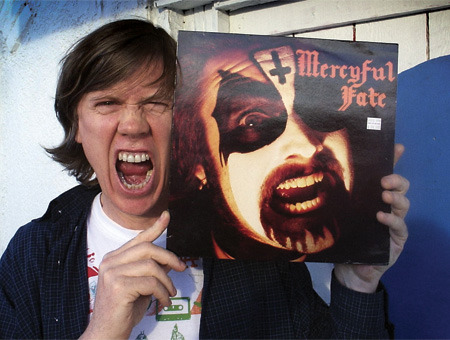
What, you don’t know Thurston Moore? Blake Judd could probably introduce you if you help him score some dope.

Who knows. For better or worse, she wouldn’t be the first hipster in the black metal world (they’re breeding like flies on a dead horse, it seems). If Myrkur wants to keep up the black metal, my advice to her is to can the mysterious solo woman shtick, get a real drummer, and see what happens. I’ll keep listening (for now).

The Evolution of Unicellularity

Posted by Jeff Morris on August 17, 2014
Posted in: Evolution. Tagged: bacteria, BEACON, Luca, multicellular, origin of life, unicellular. 1 Comment

It’s the annual BEACON center gathering this weekend, when us evolution-in-action eggheads gather and think deep thoughts. One session I attended today focused on major transitions in evolution that change the level on which natural selection acts. For instance, natural selection can act on the level of a single cell, a collection of cells acting as an organism, or on a society of related organisms. There’s of course a lot of argument over when and how multi-level selection works (or whether it’s ever important), but that wasn’t the point: we were interested in the evolutionary events that produce the levels.

One of the conveners of the session was Will Ratcliff, who as a postdoc in Mike Travisano’s lab at the University of Minnesota did some very inventive work where he coerced a single-celled yeast to form a multicellular morphology.

What Ratcliff did was to briefly centrifuge populations of yeast unicells growing in test tubes and then use the very bottom of the culture to seed a new population. In this way, only the heaviest cells — the ones that were pushed to the bottom of the test tube by the centrifuge the fastest — survived to the next generation. By repeating this artificial selection for many generations, Ratcliff evolved yeast that stayed stuck together after cell division. Since mothers stayed glued to their daughters, these yeast formed large “snowflake” clusters composed of many cells.

Ratcliff and Travisano’s “snowflake yeast”

In their 2012 PNAS paper, Ratcliff and co-workers argued that the snowflake yeast had undergone a major transition. Whereas the ancestral yeast lived, fought, and reproduced or died as single cells, the evolved snowflakes were selected together, much like any other multicellular organism (like you and me, for instance). Some of Ratcliff et al.’s arguments about programmed cell death strike me as highly speculative and poorly supported, but nevertheless they made a good case that the snowflake morphotype was a multicellular organism. Ratcliff has gone on to use this experiment as the basis of a very cool teaching exercise for undergraduates.

The really neat thing about the paper, and why it garnered so much attention, was just how easy it was to turn a “simple” unicell into a “more complex” multicellular critter. All the blathering flat-earth Creationists want to believe that every big step along the line from bacteria to humans represents some insurmountable problem that selection can’t be expected to cross. We argue that none of those big steps are really all that complicated or difficult to take, and Ratcliff showed that this was definitely the case for the transition to multicellularity.

But as I listened to Will talk about this work today I started to wonder: was the transition to multicellularity really an important transition in the ancient history of life? We sort of assume it was, and we assume that the single celled bacterium is the simplest possible kind of life. Maybe that’s so, but does it follow that, because the single-cell is simplest, that it’s also the most ancient?

Is it possible that the Last Universal Common Ancestor — let’s call it Luca — of all extant organisms was a multicellular organism?

Let’s think this through. Life probably originated on (or in) a surface. Not only are there more options for chemical reactions and catalysis on surfaces, but absent swimming or buoyancy or whatever, the first living systems would have eventually sunk until they landed on something solid. Given that, as these systems grew, they’d usually stay in more or less the same place. If they moved, it would be because physical forces sheared them away from their surface and carried them off in chunks to some other place.

The great microbiologist Carl Woese put a lot of thought into what Luca would have been like. He envisioned something he called a “progenote” — a pre-cellular bag of chemical reactions with no clearly defined genome. Imagine genes floating about in a membrane-bound soup as independently replicating units, much like modern plasmids. Such a thing wouldn’t reproduce in any way we’re used to thinking about. “Cell division” would probably occur in a manner analogous to how oil bubbles fragment when you shake an emulsion. And when bubbles blebbed off, they’d probably take a partially random assortment of genes with them.

At some point, biochemical pathways would have arisen that had incompatible intermediates, and active partitioning of components — the formation of something akin to a modern cell — would have been selectively advantageous. But even then, the boundaries between “individuals” would have been extremely porous even by bacterial standards and genes and their products would be rapidly shared throughout the local community. Thus, these non-motile organisms would still have existed in highly interdependent populations in close association with each other.

It’s hard to call Luca a multicellular organism, but it isn’t properly unicellular either. Let’s think, then, about what had to happen to produce a truly unicellular organism:

  • First, you have to package enough genes into one soap bubble to reliably produce all your basic molecules by yourself. In the Archaean world, before the accumulation of complex organic matter in the biosphere, that meant prototrophy — the ability to make all the amino acids, all the membrane lipids, all the nucleotides needed for life.
  • Next, you need to firmly separate yourself from your parent. In Ratcliff’s snowflake yeast, it turns out that the unicellular form requires active expression of a protein that breaks daughter cells off from their parents, and when that protein is deactivated, the cells remain stuck together and form snowflakes. In other words, the default is to stay stuck together and it requires energy input and a novel enzyme to break apart.

  • Last, you need some way to operate as a single cell. Even if you’ve declared yourself independent of your parents, if you can’t walk out the door and drive away it’s all vainglory. For an American teenager, getting away from Mom and Dad probably requires a car. For a bacterium, it probably means motility.

Probably took a little time to put this baby together…

Motility! One of the most spectacularly complicated and energy-demanding activities of the microbial world. If the default is to stick together, and it takes proteins and fancy whiz-bang flagella to live as a single cell, then it stands to reason that unicellularity is a derived trait, and the big transition was from multicell communities to planktonic single cells, not the other way around!

Why might a cell want to leave the collective and strike out on its own? Mooching, and the possibility of the tragedy of the commons, is always a problem when cells try to socialize with each other. Also, swimming away from the blob might result in better access to nutrients, or freedom from toxic waste products. More darkly, maybe what you really want is to eat your neighbors, and having devoured Mom and Dad, you need to swim off in search of fresh blobs to conquer.

Much of what I’ve written here could also apply to how we think about human society. There’s always this strange desire to think of humans as atomized individuals that need to be whipped up into societies by governments, cops, gods, or whatever. But I think we can safely say, based on observations of all the other primates, that our ancestors were strongly social, and that the collective is the natural state of human beings. The derived state is that of individuality, and maintaining the conditions that allow individual liberty requires a lot of energy and cultural adaptation. In other words, you don’t have to do anything at all to get people to form societies, but it takes constant vigilance to protect ourselves from those societies.

The Invisible Hand of the Black Queen

Posted by Jeff Morris on July 28, 2014
Posted in: Economics, Evolution. Tagged: Adam Smith, black queen hypothesis, dirigisme, free market. Leave a comment

I’m guest-blogging this week at the BEACON Center for the Study of Evolution in Action, so check out my post on economics, microbial social evolution theory, and the Black Queen Hypothesis.

In the BEACON post I link to a great article by Matt Ridley on the similarities between free market economic theory and Darwin’s theory of evolution by natural selection. I didn’t show the best quote from Ridley’s article though, because it was too political for an academic website. When you read it, you’ll see how it fits the Antisocial Darwinist’s mission pretty much perfectly (links and emphasis added by me):

“Today, generally, Adam Smith is claimed by the Right, Darwin by the Left. In the American South and Midwest, where Smith’s individualist, libertarian, small-government philosophy is all the rage, Darwin is reviled for his contradiction of creation. Yet if the market needs no central planner, why should life need an intelligent designer? Conversely, in the average European biology laboratory you will find fervent believers in the individualist, emergent, decentralised properties of genomes who prefer dirigiste determinism to bring order to the economy.” — Matt Ridley

Posts navigation

← Older Entries
Newer Entries →
  • Recent Posts

    • “Make Biology Great Again, Mr President” March 7, 2025
    • How to Rig an Election If You’re a Scientist February 9, 2023
    • Found: Nazi Flag in the US Capitol December 21, 2022
    • For Giving Tuesday, Support a Cancelled Professor November 29, 2022
    • The 20th Anniversary of Palindrome November 20, 2022
  • Enter your email address to follow this blog and receive notifications of new posts by email.

The Antisocial Darwinist
  • Subscribe Subscribed
    • The Antisocial Darwinist
    • Join 58 other subscribers
    • Already have a WordPress.com account? Log in now.
    • The Antisocial Darwinist
    • Subscribe Subscribed
    • Sign up
    • Log in
    • Report this content
    • View site in Reader
    • Manage subscriptions
    • Collapse this bar
 

Loading Comments...