The Antisocial Darwinist

Black sheep science from the Right side of campus. Plus music reviews.

  • About the Author
  • Contact Me
  • Music Reviews

Lone Wolfe: As Good As It Gets

Posted by Jeff Morris on April 26, 2014
Posted in: Music Reviews. Tagged: Chelsea Wolfe, drone metal, mythmaking, surrealism. 1 Comment
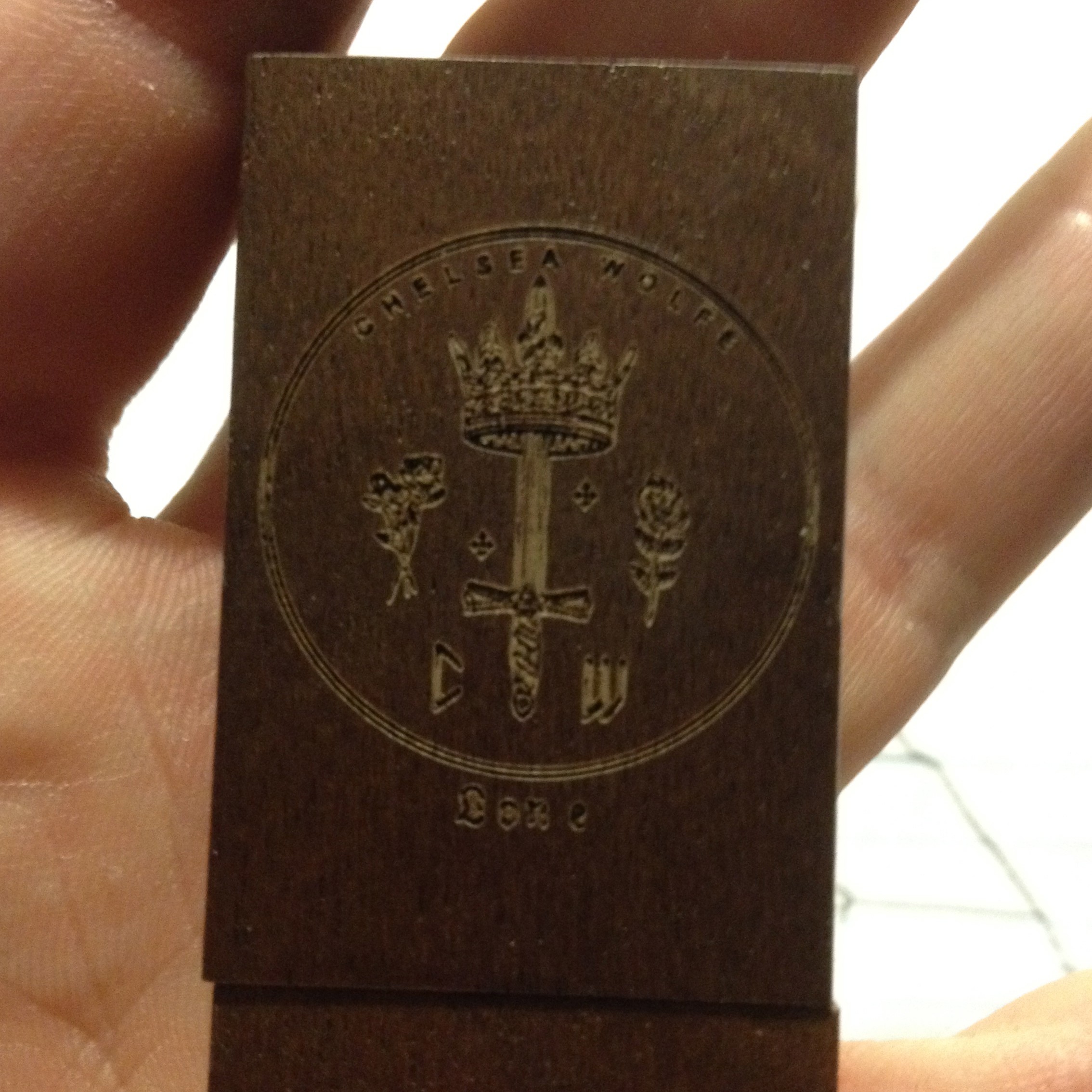
IMG_0635

Chelsea Wolfe
Lone

Origin: Los Angeles, California
Label: Sargent House
Genre: Art Folk Drone Metal
Brutality: 4
Atmosphere: 10
Calliopicity: 10
Packaging: 9

I’ll just start by saying I am a total fanboy for Chelsea Wolfe, so you should take everything I say here with a grain of salt. I don’t often go so solidly off the deep end for a musician — the last one was Summoning, and Chelsea, if you ever read this, PLEASE contribute vocals to a Summoning track the way you did for Russian Circles:

But, seriously, I’m totally obsessed with Wolfe. I originally discovered her because I heard through the grapevine about a folk singer who had covered a Burzum track:

And sure enough, it’s not just some weird anomaly. She’s clearly a metal fan: she describes her music as “art folk drone metal” and here’s a just phenomenal live-ish video of her pounding an electric guitar while wearing a cvlt-as-fvck spiked gauntlet:

But Wolfe’s music can’t be pigeon-holed very easily. It’s obviously not metal — at least as the genre is usually imagined. But if one were to distill down the elements that make “people like me” love metal, one would find many of the remaining elements strongly represented in Wolfe’s songs. The best black metal vocals sound like dissonant howls barely penetrating from Dantean Bolgias, and Wolfe has that in spades: weird, sometimes dissonant layered vocals swallowed in deep reverb. The music itself often is a hypnotic drone, beating away at a simple chord progression over and over as various barely-heard harmonies drift in and out (are they even there?) producing a spectral ambience that perfectly accentuates Wolfe’s weird vocal style. Everything lofts up into epic heights: tempo changes, jangling key shifts, and goose-bump rending crescendos. I’d say you should imagine Filosofem era Burzum unplugged, with Siouxsie Sioux on vocals — but that’s selling Wolfe short. Frankly, I’ve never heard anything that sounds like — or makes me feel like — what she does.

2013’s Pain is Beauty was a great album. But Wolfe doubled down with a collaboration with filmmaker Mark Pellington, and released the mid-length film Lone in April 2014. Pellington has a decent pedigree: videos for U2 and Alice in Chains, an episode of Homicide: Life on the Streets (maybe the best cop drama of the pre-cable era), and a few films including the creepy “true story” The Mothman Prophecies. Lone isn’t just a long-form music video: though it features five tracks off Pain is Beauty (“Feral Love”, “House of Metal”, “The Waves Have Come”, “Sick”, and unsurprisingly, “Lone”), there’s plenty more, and it’s not just four stitched-together videos. The whole thing hangs together as a solid film that would be worth watching even if you weren’t hopelessly in awe of Chelsea Wolfe.

Before I say anything about the film itself, I want to talk about the packaging of this release. Lone was shipped as a ~ 2.5 GB file on a cool wood-grained flash drive that was etched with Wolfe’s “Queen of Swords” symbol (see photo above). I love this! It’s unique, it’s pretty, it’s something I can hold on to, show my friends, etc. Two reasons it doesn’t get a “10” for packaging, though. First, the flash drive is really small, and I’m not sure where I’m going to put it for long-term storage. Second, there’s extra space on the drive, and it would have been really swell to put some extra files on — lyrics, for instance, or production notes, voice-overs, etc. Flash-drive marketing has been picking up steam over the past decade or so — a friend of mine went to a Pixies gig and actually bought a flash-drive recording of that night’s show at the merch table — and I hope it continues to improve and gain traction in the indie music world (including underground metal).

Musically, Lone is five songs separated by instrumental montages. The instrumental bits take two forms. The first, which covers the first few minutes of the film and eventually melds into vocal music with track 4 (“Sick”), is made of relentless electronic arpeggios reminiscent of Philip Glass. The second, which doesn’t show up until about halfway into the film, is a much more organic sequence of violins/strings. This juxtaposition of synthetic and natural is recapitulated in the film’s imagery, in particular how Wolfe herself is portrayed. When we first see her, Chelsea is a black-eyed mask (see the chorus of “Feral Love”, the first track in the film, “your eyes are black like an animal”), covered in pale pancake makeup — the “black Chelsea”:

Later we see her illuminated with sunlight and back-lit with white fog, in a silver dress, her stunning blue eyes obviously the director’s focal point — the “white Chelsea”. And in between these ideals, we see a “real Chelsea” — little if any makeup, tattoos, freckles — confronting death, both of others and her own. Throughout the film we see these tropes beaten against each other, the ominous black figure leading the dead off into the desert, the innocent white figure staring with imploring beauty into the camera. But perhaps most importantly, the “real” woman faces fear and death and wonder, embodying both the white and black ideals in a single living entity.

Wolfe is engaging in mythmaking with this work. We see gods: a rabbit-headed creature with no hands; twin girls, one dead, one alive; a wolf(e?) headed boy; a young girl with a grown woman mask; a dead woman on a slab; an old man with blood on his hands; lustful women orally pleasuring an inverted cross; an executioner, hard and gristled, wielding a ramshead club above a sacrificial virgin in white. And we have the intuition that all these entities are the same — all outgrowths of the thing that made Wolfe’s music.

Maybe the image that sticks with me the most, though, is that of a horse — a statue, frozen in mid-gallop, sitting alone on the beach. I think a lot of people my age remember the Black Stallion, where a horse running wild in the ocean foam was a powerful portrayal of freedom. So a frozen horse on the beach? It hurts, man, it hurts. And flip it around with an image of a corpse laying on a slab? Potent stuff.

Obviously, I could go on and on about the symbolism and what not. But you should just buy a copy and see for yourself! The take-home message from this blog should be this: Chelsea Wolfe is a serious fucking artist. Her music is capable of inducing the same sorts of overboard emotions as the best metal, but fusing it with compatible weird film and without the hassle of miking a double-bass drum kit… it’s almost unfair.

The third track in Lone, “The Waves Have Come”, closes with a sing-along extravaganza (complete with atom bomb images) with some great lyrics I’d like to share here at the end. For those of us who embrace both science and wonder, and suspect that Christianity kills both:

Creation was the only word
that made you feel you never were
an endless hope is all it was
and holding sacred all were
and don’t forsake the way we were
and don’t tell me you never would
and we don’t need physical things
to make us feel and make us dream

And for us bloody-minded Heathens who proudly embrace the end of the world and the absurdity of free will:

When earth cracks open and swallows then
we’ll never be tired again
and we’ll be given everything
the moment we realize we’re not in control
and all you know gets older when
the sun goes down and everything
begins to fade away the waves
have come and taken you to sea

End of blog: if you’re a metal fan and you’re not listening to Chelsea Wolfe, YOU ARE DOING IT WRONG.

Wild Speculation About Goose Bumps and “God Genes”

Posted by Jeff Morris on April 19, 2014
Posted in: Evolution, Religion. Tagged: evolution, evolution of religion, goose bumps, Religion, science education, teachable moments. 2 Comments

The weather up here has finally started warming up, and we’ve taken every opportunity to open up the windows and air out the house. A couple nights ago, we left the kitchen window open overnight. When we woke up the next morning, it was pretty chilly, which prompted my daughter to ask me:

“Daddy, why do we get goosebumps?”

Ermagerd, erverlurtion!

I considered telling the truth: “I have no idea.” Then I remembered that we live in an era where we have Internet-ready computers masquerading as telephones, and therefore you’re never justified in saying you don’t know something. To Wikipedia!

We quickly learned that goose bumps are caused by the same subcutaneous “arrector pili” muscles that give hairier mammals the ability to make their fur “stand on end”. On the one hand, this trait can make an animal look bigger and more intimidating, and might serve to ward off predators. On the other, it creates a thermos-like layer of air insulation between the fur’s horizon and the skin that helps keep the animal warm.

Of course, humans no longer have much in the way of fur, so these primary functions probably don’t work any more — they have become “vestigial”. I took this as a “teachable moment” to talk about evolution with my little girl. We talked about how organisms aren’t put together in clean modules like human-built machines. Because evolutionary change is driven by random mutations, it’s unlikely that all components of a biological system will change at the same time.

Humans lost their fur for reasons that almost certainly don’t have anything to do with the goose-bump function. Maybe losing fur gave our ancestors an advantage of some kind — like making them look sexier than their hairier relatives — and furlessness spread by natural selection. Or maybe once we figured out how to cut other animal’s skins off and wear them ourselves, the fur didn’t matter one way or the other and it just sort of “drifted away” by random chance. Regardless, once humans had lost their fur, the arrector pili muscles became pretty much useless. Nevertheless, they’re small and don’t take up a lot of resources, so there’s no real pressure for them to be lost by evolution, and therefore it might take a very long time for them to finally go away. Basically, the way I explained it to my daughter, goose bumps are an evolutionary anachronism, kind of like your appendix.

Or, if you’re one of these guys, your brain.

Great, science lesson for the day. But, as happens all too often when I talk to my kids about science, I started second-guessing myself later in the day. Was this scenario true? Do goose bumps serve any useful purpose in modern humans? I started thinking about all the scenarios where we get goose bumps. Certainly, we get them when we’re cold or scared, just like our hairier relatives. But we also get them in moments of intense emotion — but not just any emotion. At least in my own experience, I don’t get goose bumps when I’m angry, or when I’m doting on my kids. Frustration doesn’t do it, or stress, or intense happiness or satisfaction.

No, I get goose bumps when I experience a suite of emotions I usually classify as “religious-like”. Specifically, these are things related to the aesthetic sense: awe, the perception of beauty, the sublime sense of smallness before nature, the eureka moment of discovery or creation. In fact, I would go so far as to say that the visceral experience of these emotions is what lends them their weight, and perhaps assists in the “suspension of disbelief” necessary for the proper experience of religion and its close relative, art. And I’m pretty sure I’m not the only person who feels this way.

A long time ago, when I first started getting interested in evolution, I spent a lot of time thinking about the evolution of religion. There are many voices amongst scientists that scoff at the whole notion of belief in gods. Otherwise serious people contend that religion is just a silly fantasy, and that it demonstrably harms those unfortunate half-wits who don’t have the mental muscle to give it up.

Built by mentally challenged, delusional pseudo-chimps in the 13th century.

I never found these voices compelling. It just doesn’t add up: if religion was pathological, and was the root cause of war and suicide and self-destruction, why did it arise independently in every human population on Earth? And why does it persist, aeon after aeon, even though every population of humans — since FOREVER — has surely sampled atheism many thousands of times in every generation? If you saw these characteristics — parallel development and stability in the face of alternate character states — in any other phenotypic trait, you would assume they were supported by strong natural selection.

So I concluded, and still believe, that religion evolved by natural selection. I also believe (with very little evidence) that religion and religion-like behaviors remain the lynchpin of the numinous collective trait called “culture” that stabilizes large-scale human groups (or “races”, sensu lato). I’ve often wondered if there are “God genes” in humans that make it easier to believe in these kinds of ephemera. And while thinking about goose bumps, I started to wonder if they might shed some light on where one might look for those God genes.

Ever heard the term “God-fearing?” I always thought it was a goofy, hellfire-and-brimstone revivalist preacher trope. But what if the aesthetic/religious sense of modern humans evolved from a re-purposing of the limbic system (the part of the brain that controls goose bumps, sexual desire, terror, etc.) from simple fight/flight decisions to the “loftier” goals of god-making? One can imagine that the first counterfactual thoughts originated in fear: what if there’s a wolf behind that tree? And from the imaginary (but not really imaginary) wolf, it’s a short jump to imaginary (but not really imaginary) people, or grand immortal generation-spanning abstractions like deities. The signals originating in the limbic system feel external to our consciousness: for instance, when you fight down your fear of something, or learn to control some impulse or reflex, it feels distinctly like your “software” is dominating something external to it. Thus, fantasies arising in the limbic system would feel more “real” than the products of cerebral imagination. Mix all that limbic soup together — terror and sex and subconscious hallucination — and bam, god and art and human culture pop out the other side.

Or maybe not. Like the title says, wild speculation based on a 5-minute conversation with an 8-year old. Something fun to think about over the Easter/Passover weekend.

Why Don’t People Believe In Evolution? Part II: Pareto Optimization

Posted by Jeff Morris on April 12, 2014
Posted in: Economics, Evolution, Religion. Tagged: belief in evolution, evolution, multi-dimensional optimization, pareto, Science vs. Religion. 1 Comment

In an earlier post I argued that, ironically, disbelief in evolution evolved because it acted as a “greenbeard” for religious “conservatives”, improving their fitness by enhancing their group solidarity. Here I’ll approach the question from a slightly different angle: even if it stopped providing any benefit, disbelief in evolution would probably persist because of a common engineering problem broadly called “Pareto optimization“.

The Pareto in question was Vilfredo Pareto, an accomplished Italian thinker who was one of the first people to apply hard scientific rigor to the study of sociology and economics. Indeed, Pareto’s era was the zenith of sociology, before the discipline became a clearing house for overeducated Marxist wingnuts. From what I’ve read about him, Pareto was pretty controversial even in his own day, but if he were working today, his Darwinian ideas about social organization would give the left side of campus a self-righteous conniption fit. It probably wouldn’t help that Pareto was (and is) pretty popular with the goose-stepping crowd, so no matter how brilliant he was, he’d end up in the same pigeonhole as Nietzsche, Heidegger, Evola, and Von Braun. Of course, ASD cares not for your foolish mortal politics, so here are a few snippets about Pareto’s thinking:

Pareto believed in freedom. He complained about what he thought were unnecessary abuses against the powerless, and he complained about corruption in high places. Marxists had a solution to the distribution of wealth and powerlessness problems, but Pareto was opposed to their solution, and for Pareto the ideologies of liberals and socialists were just smoke screens for leaders who were as inclined to enjoy the privileges and powers of the governing elite that they replaced. He viewed democracy as of no help to the poor, and in a 1900 article Pareto declared democracy a sham. — Frank Smitha

At the bottom of the Wealth curve, he wrote, Men and Women starve and children die young. In the broad middle of the curve all is turmoil and motion: people rising and falling, climbing by talent or luck and falling by alcoholism, tuberculosis and other kinds of unfitness. At the very top sit the elite of the elite, who control wealth and power for a time – until they are unseated through revolution or upheaval by a new aristocratic class. There is no progress in human history. Democracy is a fraud. Human nature is primitive, emotional, unyielding. The smarter, abler, stronger, and shrewder take the lion’s share. The weak starve, lest society become degenerate: One can, Pareto wrote, ‘compare the social body to the human body, which will promptly perish if prevented from eliminating toxins.’ Inflammatory stuff – and it burned Pareto’s reputation. — Mandelbrot and Hudson, as quoted in Wikipedia

See? Economic distributions arise by evolutionary processes, and have nothing to do with moral decisions made by some mysterious “One Percent”. I couldn’t agree more, and hell, if that makes me a fascist, polish my jackboots and call me Benito.

Evidence of my fascist tendencies: I find this adorable, even though I HATE KITTENS.

During his long career Pareto learned a lot about the dynamics of economic systems, but the idea that has gained the widest traction amongst biologists is that of “Pareto optimization”. Imagine a young child going to school — at first she doesn’t know a whole lot, so it’s possible for her to pretty much saturate her ability to learn math, literature, and science at the same time. However, as she grows up and get educated, it takes more and more effort to reach the “next level” in any one subject, and decisions start having to be made about how to allocate time. If she decides to spend more time on math, she’s not going to have as much time for literature or sports. The problem only gets worse with time, and once you’re at the rarefied heights of grad school, it’s easy to find yourself doing literally nothing but studying one bizarre invertebrate that no one has ever heard of, even to the exclusion of social activities, exercise, eating, etc.

We claim this lobster lip in the name of Cycliophora!

Thus, you can only make costless “Pareto improvements” for so long before you approach a “Pareto frontier” where any further improvement in one function produces a negative influence on at least one other function. In evolution (and probably other fields) we call this a “trade-off” and it’s one of the reasons why there aren’t any “perfect” organisms out there. It’s probably also why the whole “car/boat hybrid” thing never took off, why there are so few multi-sport athletes or scholar athletes competing at the professional level, and why the spork is inferior to either a spoon or a fork.

In this figure, we’re trying to minimize two traits (represented by the two axes). When both traits are far from ideal, it’s easy to improve either or both (top right). As they approach the perfect “utopia point” they eventually reach the Pareto frontier, where it’s impossible to improve one trait without damaging the other one. The trait space beyond the Pareto frontier is unreachable.

So, when you’re sitting on a Pareto front, you have to make decisions. Which traits do I really want to maximize; what are my priorities? Unless you’re devoted to being as spork-liciously mediocre as possible in as many traits as possible, you’re going to specialize, and that’s going to cost you something somewhere.

So how does this connect back to belief in evolution? The problem is that scientists and laypeople have very different priorities. As we mature and approach our own personal Pareto frontiers, we start optimizing for our chosen professions. Scientists (hopefully) optimize truth-seeking and intellectual honesty. We voluntarily submit ourselves to a sado-masochistic peer-review process that supposedly prevents us from professional dishonesty, kind of like a great intellectual chastity belt.

After a decade or six obsessing over intellectual honesty — and suffering the travails of academic publication and watchdoggery — we expect everybody else to obsess over it too. But that’s kind of like a priest, having mastered the dubious art of celibacy, expecting everybody else to have a similar mastery over their gonadal urges.

But why should they? Outside of science, honesty and accuracy are probably generally good ideas, but do “normal people” really benefit from taking it to the extremes that scientists do? Probably no more than they would benefit from celibacy. No, most people optimize more sensible things, like getting along with their neighbors, co-workers, and friends. And if that means not thinking too deeply about certain things that your neighbors, co-workers, and friends might be wrong about, well, so be it.

And it’s not like scientists are any better about being intellectually honest in their private lives. The degree to which academics turn a blind eye to the utterly innumerate claims of the leftist politicians they idolize boggles the mind. The idea that somebody could aggressively nitpick parametric vs. nonparametric statistical methods in a paper about lizards fucking, and then nonchalantly accept the idea that eternal deficit spending is a good idea — that’s hard to swallow, man.

My guess as to why academics do this? Academia slowly drifted leftwards over decades for complicated reasons, and at some point a critical mass was reached where, in order to live a peaceful and sociable life, it was advisable for an academic to at least act like a good leftist. In other words — it doesn’t matter if the ideas are grounded in truth, if they’re productive, or even if they make sense. People believe them because they’re optimizing sociability, not political science or economics.

Ultimately, academics don’t believe in capitalism for the same reason that many “normal people” don’t believe in evolution. It doesn’t matter how much evidence supports something: you’re unlikely to believe something that makes your colleagues think you’re a douche. You can see this trend all around you: the choice between truth and practicality is usually a Pareto optimization problem, and we choose the latter over and over again in our lives. It’s absurd to expect “normal people” to treat scientific truths any differently than any other truths.

I’ve made two arguments here, first that disbelief in evolution is actively selected amongst Christians because of the greenbeard effect, and second that it expands from that Christian core because of the Pareto impossibility of simultaneously maximizing truth and sociability. Does this mean that we can’t increase the American public’s acceptance of evolution? Probably not by just harping on the scientific evidence. But there are other tactics that I do think will work. But that’s for another day…

The New Behemoth Record is About Reviewer #3, Agent of the Utangard

Posted by Jeff Morris on April 3, 2014
Posted in: Music Reviews. Tagged: behemoth, black metal, death metal, occult, satanism, the satanist. Leave a comment

Behemoth
The Satanist

Origin: Poland
Label: Nuclear Blast
Genre: Occult Death Metal
Brutality: 8
Atmosphere: 8
Calliopicity: 8
Packaging: ***

Like you don’t know who Behemoth is. What, you’re here because you thought this was a science blog? Okay, sorry…

Behemoth is a 4-piece death metal coven from Poland. They’ve been around forever. The band was formed in 1991, back when I was screwing around in my first band playing crappy rip-offs of Celtic Frost and Slayer. Of course, that’s probably what Nergal was doing too, at the time, but hey, it worked for him, and I ended up as a scruffy scientist. Go figure.

Behemoth exuded a number of solid necro-strength black metal records in the 90’s and then graduated to fancy studio-quality death metal in the aughties, resulting in American tours and substantial financial success. I saw them at some point around 2004 (the Demigod tour, I believe) at the Masquerade in Atlanta. My recollection is that they had very creepy Polynesian masks or something. It was definitely their image that stuck with me more than their music. Behemoth definitely has a unique, and unignorable, fashion sense:

Their latest album, The Satanist, is definitely worth a listen or 5. It’s got all the elements that make me seethe with pleasant hatred. It alternates between head-bobbing moshy bits and blast-beating air-drumming sections — check out the dynamic range between tracks 4 (“Ora Pro Nobis Lucifer”, the best single track on the record), 5, and 6. It’s got a bunch of those 8va wheedly-wheedly riffs that cut through the bassy chaos like the screams of pitchforked sinners. There are some great hooks on this record, bits that will stick in your head and have you singing lyrics like

Behold the great accuser
A
megalinga of throbbing zeal

over and over around your unsuspecting work friends. The drums are distinct but not too triggery — the individual toms are distinguishable from time to time, and you can even hear what appear to be actual cymbals here and there. And there are synths that are cleverly and effectively worked into the music, adding atmosphere and depth. For instance, there are “horns” in track 6 — the title track, “The Satanist” — that sound quite solid. The obvious comparison is the horns in Emperor’s “Alsvartr” — an otherwise spectacular track, but when the horns pop in, first-time listeners have a tendency to sit up and say “What the fuck is that shit?” No, Behemoths’ horns work, and the synths return in the epic final track “O Father O Satan O Sun” to produce a many-layered, vocoded choir praising the Adversary. It works. Hail Satan, dude.

You can’t talk about Behemoth without talking about Nergal, the vocalist/lead guitarist. He’s the only permanent member, and based on the liner notes he literally wrote everything on this record, lyrics and music. Never mind that he was incapacitated for a year or so by a well-publicized bout of leukemia. I suppose he’s a very motivated guy, and he’s certainly open to voicing his opinions. But as I look at the lyrics, and the art, and everything about Nergal’s band, I find myself asking, “What does this guy actually believe?”

First, I’ve got to give him credit for writing lyrics in reasonably well-assembled English. That’s a rarity even amongst English-as-a-first-language death metal bands.

But where is he going with some of this stuff? I get it that Behemoth is all about “the occult” whatever that means. Sort of moving backwards from the rest of the metal world, they’ve moved from Heathen-inspired themes in their old work to “Satanic” themes on their later records. Sometimes I look at Nergal’s stuff and I wonder if he’s serious, or if he’s subtly making fun of people like me. There’s a lot of Bible-inspired antichristian crap in there, all swallowed up with fancy words to make it seem more high-brow than “Hell Awaits“. There’s also a lot of occulty buzzwords that pop up — “Zos Kia” and “Thelema” and all that. There’s a lot of penis imagery and solar ideolatry — not sure whether David Wong or Louis Farrakhan is a stronger influence for some of these ideas, but hey, if you’re going to start a cult, might as well do it with swastikas and giant dongs.

So who is “The Satanist” in this record? If I give up my idea that I’m being made fun of by Nergal, I might believe that he sees the image of Satan as I do — the “Adversary” of, well, whatever. In Heathen philosophy, this entity would be the embodiment of the “utangard“, the lawless realms outside of society. In this incarnation, Satan is the “God of the Middle Finger”, the eternal fly in the ointment, and the Reason We Can’t Have Nice Things. Here’s a great line from the title track:

I am the fly that flew forth from the ark

Yeah, cause the Noah myth is all in the news now, with big Russell Crowe biceps and all. Jehovah’s awesome genocidal plan to fix the world was screwed from the beginning, because all the corruption of reality followed along with whatever life “He” sought to preserve. Decay and horror and conflict are inevitable products of natural systems.

So that urge to say “No, you are fucking wrong” is the embodiment of Satanism. Scientists, every time you peer-review your colleagues’ work and say, “This is total shit,” you are doing the work of the Devil. You ought to say, “Oh, we’re all the same, I feel your pain, it’s hard to get a job, here’s a publication, I hope things work out for you.” But instead you say, “Your ANOVA was calculated wrong. Go back to grad school, do not pass Go, do not collect $200.” SATAN.

Really, guys. Quit trying to cozy up to the christers and play nice, like you’d be on their side but for the evolution thing. No, there’s an insuperable void separating us. We scientists aren’t just doing Satan’s work, our whole system is the living embodiment of Satanism, and in fact only works because of our absolute philosophical devotion to Satan and his ideals. \m/

Moving on: all in all, this is my favorite Behemoth record so far. All their earlier albums have toyed with ideas and musical motifs that had the sort of suggestion that sort of maybe they would be awesome at some point in the future, but on The Satanist those elements are finally starting to come together. Behemoth isn’t going to become my favorite band any time soon, but this is a strong album and further cements their position in the canon of extreme metal.

*** I can’t comment on The Satanist‘s packaging because my CD got lost in the mail. Fortunately, I was able to download it thanks to Amazon’s cloud player service. But still, the shoddy delivery service we get from UPS etc. makes my mission of lauding physical music substantially more difficult.

Experimental Evolution and Beer

Posted by Jeff Morris on March 27, 2014
Posted in: Evolution. Tagged: artificial selection, beer, evolution, natural selection, yeast. Leave a comment

How cool is this link my friend and colleague Luis Zaman sent out:

Bone Dusters Paleo Ale, Brewed from Real Fossils!

“Osborne and Akerboom were hoping for a brewing revelation – an entirely new strain of wild yeast that would shake the brewing industry to its core and open up a whole new world of possibilities for craft brews. What they discovered turns out not to be an entirely new species, but rather a new subspecies of the yeast well known to breweries and wineries worldwide: Saccharomyces cerevisiae. They’re calling the new variant Saccharomyces cerevisiae var protocetus after the protocetid whale fossil it was swabbed from.”

That’s right. They cultivated their yeast from a fucking petrified whale skull. Well, I’ll drink it (ed. note, ASD will drink pretty much anything), but it might not be as awesomely unique as it sounds. When I saw the headline, I was expecting to read about actual fossil yeast, like for instance something cultured from an urn in an ancient Egyptian brewer’s tomb. But no, they’re just swabbing fossil bones — which means they’re just culturing normal, modern wild yeast that happen to be hanging around in museum vaults or in the soils where the fossils were discovered. Ask any brewer about beers made from wild yeasts — or better yet, sample a lambic or a sour ale for yourself. Brettanomyces is a common wild strain, and has a reputation for tasting like black pepper or band-aids, depending on who you talk to.

Brett and other wild yeasts are very popular with the “cool beer” kids because of their wildly funky flavors, contributed by the variety of “secondary metabolites” they produce. But why do the wild yeasts produce more secondary metabolites than the domestic Saccharomyces cerevisiae we’re more familiar with?

The term “secondary metabolite” tells the story. To the yeast, there’s nothing “secondary” about these flavorful products. They make them for important physiological reasons — sometimes as antioxidants, sometimes as opportunistic electron acceptors during fermentation, or for any number of other functions. We call them “secondary” because all we care about is achieving the highest efficiency yield of the “primary product” which is good old ethanol.

Over the millenia that humans have been intentionally fermenting sugars, traits have been selected that favor increased yield of ethanol. The easiest way for a cell to make more of one product is to make less of another one — hence selection for more booze means fewer “secondary” metabolites. This is an example of “artificial selection” and is similar to the production of domestic cattle and grossly exaggerated seed size in maize (i.e., ears of corn), and those absurdly big-breasted roaster chickens you find at the supermarket.

Careful thinking about artificial selection was one of several elements that led Darwin down the path to his theory of natural selection. Today, many of us engage in a more academic form of artificial selection — experimental laboratory evolution — which largely involves transferring microbes from one culture to a fresh one over and over and over, and observing what sorts of mutations arise as the microbes adapt to the environment where we raise them. We’ve been able to use this method to directly test the mathematical predictions of evolutionary theory, and it’s even yielded unexpected insights into the nature of the evolutionary process itself, as well as the evolution of novel complex traits. All in all, experimental evolution is “gee whiz” science at its best, and I thank the gods (and my funding agencies, NASA and NSF — love you guys) that I get paid to be a part of this kind of thing.

But even before I got my hands dirty at the bench, it occurred to me that brewers have been using the exact same methods for thousands of years. While brewers must have understood that fermentation was caused by some sort of living, growing thing, it wasn’t until the great microbiologist Louis Pasteur started investigating the pathogenesis of beer souring that it was understood that yeast was a microbe. Even then, the isolation of pure cultures had to await Robert Koch’s fortuitous observation of bacterial colonies growing on a decaying potato. So, almost every batch of alcohol produced for the first 5,000 years of the brewer’s craft was produced by transferring yeast from a previous batch.

The implications of this transfer process go far beyond what we normally think of as artificial selection, and are a perfect illustration of why evolution looks different to microbes than it does to “charismatic macrofauna” like ourselves. One of the most important factors determining how evolution affects a species is population size: the larger the population, the easier it is for natural selection to work. Imagine that the critters are playing the lottery trying to find a “winning ticket” mutation — the more chances they have to draw a number, the more likely they are to win.

When humans were selecting cattle, or corn, or big chicken boobs, we were working with extremely small population sizes — just the animals we kept in our farms, maybe a few hundred individuals. And when we picked the best and brightest of our charges to breed, the effective population size dropped to 2 individuals — the mating pair. Thus, the only selection that could happen was what the humans intended.

But think about yeast — in a single 5-gallon batch of homebrewed beer, there are roughly 1013 yeast cells — that’s 10 million million individuals. Even if only 1 in 1000 of those cells is transferred to the next batch, we’re talking about a population size greater than the entire human race. Prior to the ability to select a single yeast “clone” using Koch’s method of colony isolation, we weren’t able to pick single yeast individuals to breed, so our ability to pick the best strains was limited at best. And because of the great population sizes, the yeast were evolving on their own the entire time as well.

The homebrewer knows the results well — dozens of unique yeast strains, cultivated throughout the European diaspora (and beyond), each with distinct flavor profiles and growth characteristics. Some float, some sink; some leave cloudy beer, some form a thick skin at the surface; some like the cold, and some prefer warmer temperatures. Some ferment “clean” and some leave lots of fruity secondary metabolites. Almost none of these traits have been intentionally selected, although modern techniques have allowed the development of spectacular workhorse strains like the monster used to produce Samuel Adams’ Utopias. No — the delicious diversity of modern beer and wine is the result of good old-fashioned natural (not artificial) selection, caused by massive populations of yeast adapting to the unique environments of breweries in Belgium, Germany, Britain, Russia, France, Italy, etc, etc, etc….

So I’ll drink the whale-bone beer — but if you want to taste evolution, really, any beer will do.

Posts navigation

← Older Entries
Newer Entries →
  • Recent Posts

    • “Make Biology Great Again, Mr President” March 7, 2025
    • How to Rig an Election If You’re a Scientist February 9, 2023
    • Found: Nazi Flag in the US Capitol December 21, 2022
    • For Giving Tuesday, Support a Cancelled Professor November 29, 2022
    • The 20th Anniversary of Palindrome November 20, 2022
  • Enter your email address to follow this blog and receive notifications of new posts by email.

The Antisocial Darwinist
  • Subscribe Subscribed
    • The Antisocial Darwinist
    • Join 58 other subscribers
    • Already have a WordPress.com account? Log in now.
    • The Antisocial Darwinist
    • Subscribe Subscribed
    • Sign up
    • Log in
    • Report this content
    • View site in Reader
    • Manage subscriptions
    • Collapse this bar
 

Loading Comments...