Lots of people don’t believe in evolution. This is shocking to ivory-tower academics who almost never interact with the nonbelievers. Hell, I guess I’m one of those sheltered souls. I don’t think I’m on a first-name basis with a single church-going Christian that I’m not related to. In literally every social circle I move in, one can casually talk about the evolution of the human species or the abiotic origins of life without having to look furtively about to see if anyone has taken offense.
But the society of the American ivory tower is the exception. An often-cited 2006 paper in Science shows two shocking facts. First, less than half of Americans believe the theory of evolution is accurate. Second, the US has the lowest rate of belief in evolution of any first-world country. Most American scientists think this is alternately scary and embarrassing. What bothers me most is simply that it is so shocking, because this disbelief is absolutely not a part of my day-to-day life. It suggests that “Evolutionists” and “Creationists” socialize in different places, shop in different stores, read different magazines and websites, watch different movies and TV shows. We don’t date or marry each other. We really aren’t a part of the same society at all, despite the fact that we live in the same country, share all the same resources, and are ruled by the same government. We are like de facto races, self-segregated because our ways of life are bizarre and, possibly, disgusting to each other.
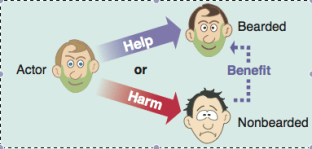
The “greenbeard” lets the players know who to help and who to hurt. Adapted from West and Gardner 2010, Altruism, spite, and greenbeards. Science 327:1341-1344
It’s easy to segregate yourself from hated rivals when you have a nice defining character. In evolutionary biology, we call that sort of thing a “greenbeard” for esoteric reasons. The general idea is that a recognizable “tell” that is invariably linked to a certain group of other, harder-to-detect traits can help similar individuals find each other in a crowd and give each other preferential treatment. Greenbeards are a principle trick for evolving social interactions and “altruism”.
So wearing a greenbeard helps cooperators keep the benefits of their cooperation for themselves by a) seeking each other out and b) excluding those beardless sonsofbitches who might want to take their stuff. I’m arguing here that, for the American fundamentalist Christian, disbelief in evolution acts as a greenbeard. It clearly and necessarily discourages admixture between Christians and everyone else.
The best greenbeards are cheap. An organism has to get more benefit from cooperation than it pays for its greenbeard to make growing the damn thing worthwhile. Disbelief in evolution carries no benefit in itself. Indeed, it’s a “non-trait;” purely negatively defined. It isn’t a thing, it’s the absence of a thing. On the other hand, outside of professional science, it probably doesn’t carry much of an obvious cost, either: the ancient origins of mankind, and life in general, arguably don’t have much bearing on most people’s daily lives. The choice to believe or not believe in evolution, viewed in this manner, is therefore not a “living”, or important, choice. The 20th century American philosopher William James, in his essay “The Will to Believe”, wrote that a choice has to be “momentous” in order to be “living”, which is to say, for it to matter what choice one makes. By “momentous” he means that what is chosen must cause some significant effect on one’s life.
I think many people would accept this statement — that the phenomena putatively affected by evolution are distant and occupy a scale so vast as to exclude normal human experience. Given that, belief in evolution appears to be a nearly neutral trait, and in evolutionary terms it can be gained or lost at random in a population. Nearly-neutral traits are ripe targets for evolutionary innovation (for instance, neofunctionalization following gene duplication). In this case, disbelief in evolution evolved into a greenbeard trait for Christians.
How did this happen? Let’s say we start with a population split between atheists, all of whom believe in evolution (having no competing beliefs about the origins of species), and Christians, who are mixed in their beliefs (see figure below, where Darwin-heads mean belief in evolution and halos indicate Creationists). Initially the belief trait is irrelevant, and amongst the Christians it expands and contracts by an apparently random process; however, at some point one group of Christians notices that they all disbelieve in evolution (possibly just by chance), and all of the non-Christians believe in it. Moreover, whereas Christians could in principle believe either in Creation or Evolution, atheists have no alternative belief: belief in creation is thus a permanent and specific barrier between the faithful and the profane. Displaying the greenbeard of disbelief in evolution unites Christians, helps them find each other, and separates them socially and genetically from non-Christians. Whereas the belief in evolution carries no cost or benefit in itself, the greenbeard provides a selective advantage for Christians, emphasizing the divide between them and the rest of the world, filling pews and making money. Perhaps more importantly, money and socialization help Christians have more sex with other Christians, thus making more Christians and simultaneously keeping filthy Evolutionist DNA out of the breeding pool. Thus, disbelief spreads pseudo-genetically (by belief transmission from parents to children) and also “memetically” as Christian evolutionists see how successful disbelievers are and decide to change their belief status.
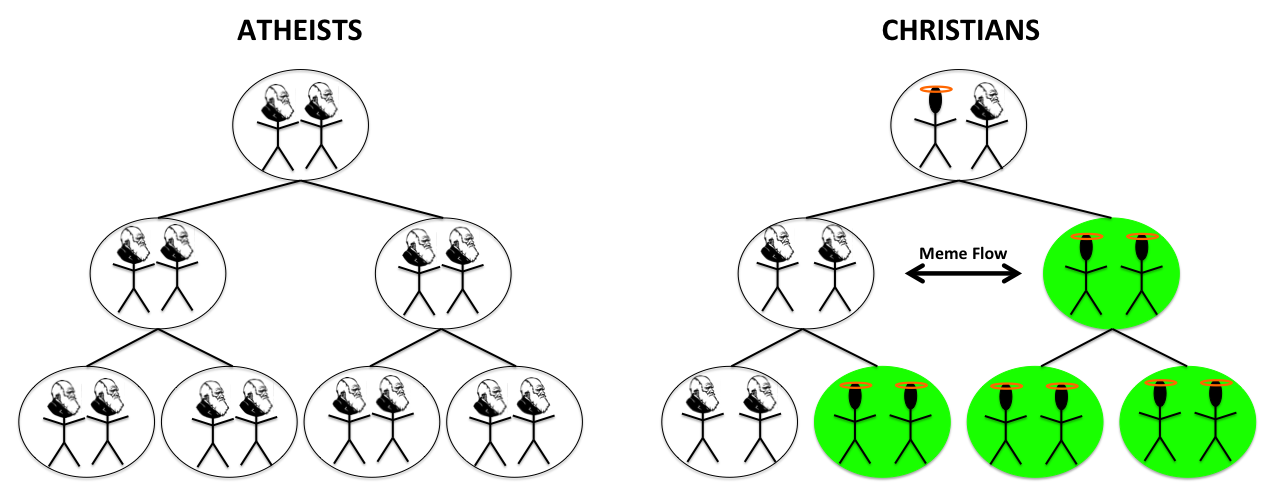
So there’s my case that disbelief in evolution is a greenbeard. I would also like to encourage you to think briefly about whether, in some cases, belief in evolution is a greenbeard. When scientists, and the scientifically literate, object to creationism, we do it because we understand the weight of evidence supporting evolution. I wonder, though, if perhaps there are pockets of people out there who believe in evolution not because they understand it, but because hated Christians don’t believe in it. A greenbeard for clueless college leftists, perhaps? Perhaps a similar dynamic holds for belief in climate change? If these “controversies” are in fact driven by fashionable greenbeards, it would present a bothersome problem for those of us who abhor the politicization of truth.
If disbelief in evolution doesn’t have anything to do with evolution, and everything to do with group identity, are scientists fighting the wrong enemy when they try to argue the scientific strengths of evolution against religious nay-sayers? I think they are, and will talk in my next post about how I think we should change our strategy in light of greenbeard-ism.
Why Don’t People Believe In Evolution? Part II: Pareto Optimization

 The Antisocial Darwinist