The Antisocial Darwinist

Black sheep science from the Right side of campus. Plus music reviews.

  • About the Author
  • Contact Me
  • Music Reviews

Labyrinth: Sophocles With Blast Beats

Posted by Jeff Morris on March 20, 2014
Posted in: Music Reviews. Tagged: behemoth, black metal, death metal, nergal, occult, satanism, the satanist. Leave a comment

Fleshgod Apocalypse
Labyrinth

Origin: Italy
Label: Nuclear Blast
Genre: Operatic Death Metal
Brutality: 6
Atmosphere: 7
Calliopicity: 9
Packaging: 8

Fleshgod Apocalypse is a 5-piece technical death metal band from Italy. Their latest effort, Labyrinth, is a full-on concept album telling the epic story of the Labyrinth of Crete and the tragic figures surrounding it. Tracks 2 and 7 are told from the perspective of Asterion, the Minotaur, the unnatural and hated offspring of the Queen of Crete’s affair with a particularly gorgeous bull. Perhaps unsurprisingly, her husband the king doesn’t like having evidence of her bizarre proclivities hanging about, and so the monster is imprisoned in a marvelous prison, the Labyrinth. Incidentally, the Labyrinth was constructed by none other than Daedalus, father of ill-fated Icarus (Track 4); Daedalus was also responsible for arranging the queen’s tryst with the bull, and in general is probably the first example in history of a scientist with serious ethical problems.

Most of the album, however, tells the story of Theseus, slayer of the Minotaur and eventual king of Athens. After Athens was subjugated by Crete, the Athenians were compelled every nine years to send 14 tributes — 7 boys and 7 girls — to Crete to face the man-eating Minotaur for the pleasure of the Cretan king. Perhaps seeing 2500 years into the future and channeling the power of Katniss Everdeen, Theseus went to Crete as a tribute and, rather than humbly going to his doom, killed the Minotaur, freed the other tributes, and escaped from Crete. But since nobody in a Greek story can be happy, his failure to take down the black sails from his ship as he returned home resulted in his father’s suicide (Tracks 9 and 10). Thus, Theseus returned home victorious to find himself king, but at the cost of losing his father. Brutal.

Labyrinth tells a great story, and it does it with dynamics worthy of a classical Greek tragedy. The album starts kind of slow; the first two tracks come off as a bit overdone and all-over-the-place, but by track 3 you’re starting to get used to Fleshgod’s unique operatic style. The music continues to develop, reaching a peak with track 6, “Pathfinder”, which I consider to be the best song on the album:

This track is huge, both lyrically and musically, and really captures the internal struggle of a hero against impossible odds. In a classic tragedy, the highest emotional point is right at the middle, and “Pathfinder” serves that purpose well. Fleshgod keeps building the power, and even if you were a little dubious about the record at first, they’ve really won you over by the end. “Epilogue”, which covers Theseus’ father’s suicide, is pure pathos, and really is the album’s denouement. Seriously, the record feels like a play, which I think was probably the band’s intent, so kudos, guys. They should invite you to write a soundtrack for Antigone. If the scumbags in Hollywood keep remaking all my favorite movies from the 70’s and 80’s, Fleshgod has to do the soundtrack for Suspiria.

Fleshgod’s last record, Agony, was one of my favorite albums of the past few years. Their drummer, Francesco Paolini, totally slays, and even if every other aspect of their music was complete shit they’d be worth listening to just for his skills. But what I really love about this band is their willingness to take risks with their music while still staying withing their genre. I love the incorporation of wacky musical gizmos into metal, and the explosion of pagan folk metal bands over the last decade has been really fun.

I mean, who doesn’t appreciate a death metal band with a hurdy-gurdy player?

But there’s only so many didgeridoo solos you can take before you want to get back to the basics — drums, guitars, vocals, and maybe a keyboard. Fleshgod pushes those instruments to their extreme limits. Their use of operatic male vocals is (to my knowledge) unique in metal. Sure, there are lots of virtuoso, classically-trained singers in metal and always have been, and indeed sometimes Paolo Rossi’s melodramatic crooning reminds me of a Geoff Tate or even King Diamond. But for the most part, actual opera-style singing has been limited to female-fronted D&D-bait bands. In this regard, Fleshgod Apocalypse is sort of like the unholy Minotaur offspring you’d get if Nightwish‘s Tarja Turunen climbed into a wooden bull and banged all the guys from Pestilence.

I also love how Fleshgod makes the keyboard a frontline instrument without sacrificing brutality. Usually keys are only in the atmospheric bits of a song — the old “intro” effect. The keyboardist is crammed into the back of the stage somewhere, or sometimes the keys are just a backing track — an afterthought. No doubt, keys and orchestration are both important and well-executed on Labyrinth and all of Fleshgod’s albums. And on Agony, it worked, godsdammit, and unfortunately it worked better than it works on Labyrinth. Probably the reason that keys aren’t featured more prominently in metal is the difficulty of mixing them with the guitars and vocals. There’s only so many sounds you can pack into the mid registers before it just turns into a jumbled mess. The engineering on Agony was exquisite — everything was crystal clear — but the guitars are just gone in most of Labyrinth‘s tracks. “Epilogue” is honestly the only song on the album where the guitars are prominent outside of the solos. And while all the background choirs contribute greatly to the epic atmosphere of the album, sometimes you kind of wish you could hear what those voices are saying… it’s all just a reverby mess down in there. It would really be wonderful to hear Fleshgod record with an engineer who really knows how to meld electronic instruments with metal — maybe Peter Tägtgren, if I might be so bold as to suggest…

But that muddiness is really a generic problem with progressive metal, and really with elaborate music in general. Real orchestras spend fortunes on acoustics to prevent it. For a band with a sub-million-dollar recording budget, it’s rare that the mix gets done right, and sometimes the deep layering is really the goal in itself. You shouldn’t go into Fleshgod’s music expecting mosh-pit ready riffs; it’s all about the epic experience. Listen to the record from start to finish, let it tell its story. And dig those fuckin’ drums, man.

Cosmos, Christians, and the Second Coming of Sagan

Posted by Jeff Morris on March 15, 2014
Posted in: Evolution, Politics, Religion. Tagged: Carl Sagan, Cosmos, Neil Degrasse Tyson, Religion, Science vs. Religion. 3 Comments

I finally got around to watching the new Cosmos tonight. Gotta say, I was fully prepared to hate it. Ever since I started seeing this Neil Tyson guy popping up on the Internets I’ve been pretty skeptical about him. Usually, I’d see his face attached to some meme-y blurb on a pimply atheist’s Facebook wall, passive aggressively mocking religious people, the denizens of the flyover states, all the semi-educated unwashed masses who either legitimately don’t understand science or else willfully reject it. You know, the same kind of meme swarms that often feature Bill Nye and seem to be peripherally attached to George Takei’s Facebook empire. Usually the messages are really snarky and one suspects they either a) weren’t actually said by the people to whom they’re being attributed or b) have been taken grossly out of context for the purpose of gratuitous Dawkins-esque trolling.

I find all these aggressively atheistic Facebook trolls really objectionable, if for no other reason than they make me want to defend the gods-damned Christers. And, perhaps through no fault of their own, Neil Tyson and Bill Nye have gotten turgled into the part of my brain reserved for these kind of guys.

Now, I absolutely adored Carl Sagan when I was a kid. Who amongst us over 30 can say the word “billions” without aping Dr. Sagan’s instantly recognizable voice? Lots of things contributed to my decision to be a scientist, but Sagan’s PBS specials, his books, and just knowing that guys like him were out there figuring things out had a lot to do it. (Full disclosure, so did giant Japanese robots and time-traveling dinosaurs.)

So it should come as no surprise that I was gritting my teeth about watching a remake of Sagan’s most famous product hosted by what I had come to think of as a deity worshipped by slithering hordes of Facebook Grid Bugs. I mean, don’t even get me started on remakes. You’re starting with one foot in the grave already these days when you use a loved title from my childhood and try to spiff it up for 21st century sensibilities. But Cosmos? You’re seriously treading on sacred ground there.

I have to say I was pleasantly surprised. First, prior to watching, I finally got around to Googling Tyson. Unlike Bill Nye, Tyson is a bonafide scientist, who apparently continues to contribute to original research. His most recent paper, “The faint-end slopes of galaxy luminosity functions in the cosmos field”, was published in 2008. While not stellar, his publication record is respectable, especially considering the huge amount of outreach and popular press writing he’s done.

That settled some of my concerns about “Who anointed this guy the new Carl Sagan?” At least he’s a real scientist and not just some dude people recognize from TV.

The show, then: it was good. Certainly managed to convey the scope and grandeur of the Universe, and of the Great Work of the scientist. The special effects were a lot better than they were in the 80’s. The addition of animated sequences was really fun, and is certain to catch the attention of younger kids (who really ought to be the target audience). There was one great animated bit where the persecuted thinker Giordano Bruno is set free from his prison cell into the infinite universe of his imagination; unfortunately just before he’s tortured and killed by a gang of Christian death-dealers that make Mel Gibson’s Pharisees look like an even-handed depiction of Jewish politics in Roman Palestine.

Although I have to admit the Papa Emeritus cameo was a welcome surprise.

And I have to keep on about the depiction of religion. I’m all about Christian-bashing. Hell, I pray to Odin and listen to music by loony astro-Nazis who burn churches. But Cosmos, gods love ’em, got it wrong, and they got it wrong in a seriously bad way that is becoming too common amongst scientists. The case study of Bruno as a scientific martyr was just as historically cartoony as was Bruno’s depiction; here’s a good accounting of the real problem the Church had with Bruno, who was apparently a pretty recalcitrant firebrand and theological revisionist, sort of a medieval Alex Jones. Yeah, they burned his ass at the stake, but it wasn’t because they were suppressing the “truth,” it was because they were suppressing dissent. They also burned people for all sorts of things that the Dawkins crew would mock as absurd — for instance, “witches” were blamed and executed for the 14th-15th century cooling event known as the Little Ice Age.

Which brings me to my real problem with Cosmos’ depiction of religion. Like Dawkins and his trolls, it flattens religion and conflates gnostic experience with political appropriations of religious ideology, for instance as embodied in the Catholic Church. Religion arises in the confrontation of human consciousness in its most private moments with the ineffable — not the unknown, but the unknowable. It isn’t something that can be easily shared, or universalized. Despite the inherently personal nature of religion, cult symbols often have been used by political groups in their attempts to enforce dominion, and therefore many people have come to associate the symbols and trappings of particular religions with the hated tyrants who wielded them.

But for scientists to take this attitude about religion — extrapolating from the political persecution of dissidents by the hegemonic Church to the classification of religious experience as a reprobate anachronism — invites two great mistakes. First, by focusing mistrust on the religious boogeyman, it distracts from the real enemy — political ideology and the manipulation of belief to control people. There is no important difference between what the Church did to Bruno and what the atheist Soviets did to Solzhenitsyn. Second, by attacking the straw man of the political Church, scientists miss the fact that most of us are drawn to our work by desires almost, if not exactly, identical to the desires that drive the deeply religious. Briefly, if your study of science has never led you to gaze bleary-eyed and speechless into the sublime depths of the cosmos, then you aren’t doing it right (consider a career in engineering).

I can overlook this shortcoming. I’m sure I’ll keep watching the show, and it certainly was a lot better than I was expecting. But I long for the day when scientists realize that threats to our profession come from everywhere — all sorts of political ideology are, by their very nature, inimicable to the pursuit of truth. Leftist fantasies are just as much a problem as Christian dogma, and we shouldn’t let the fact that the leftist hand is more free with grant money cloud our judgment on this issue.

WTF, Ukraine: Kin Selection and the Death of Nations

Posted by Jeff Morris on February 23, 2014
Posted in: Evolution, Politics. Tagged: ethnic nationalism, evolution, kin selection, organic nation, Ukraine. 3 Comments

I’m going to talk about Ukraine, because it’s on fire right now and because I happen to have followed its politics for the last decade or so. And I really dig a lot of Ukrainian music. Believe it or not, I’m going to relate the problems in that country to evolution. And I’m going to extrapolate to our own part of the world, with potentially dire predictions. So here we go…

The popular definition of evolution is “survival of the fittest,” an idea that brings to mind something like a big biological free-for-all that ends with one blood-soaked victor standing on top of a planet-sized mound of crushed enemies. Such a set-up doesn’t leave much room for cooperation, and indeed one of the big arguments against “social Darwinism” has always been that it leaves no room for compassion and social responsibility.

Everything in that last paragraph is, of course, utter bullshit. Cooperation is abundant in nature, and we can show that it can evolve under a strictly Darwinian regime of natural selection. Briefly, we have Hamilton’s Rule, which gives a mathematical proof that “altruistic” or self-sacrificing behavior can be selected when the recipients of the sacrifice are close relatives of the altruist. This phenomenon, known as “kin selection”, is the source of the quip by the great population geneticist JBS Haldane that he wouldn’t give his life to save a drowning brother, but he “would to save two brothers or eight cousins.” Key to making kin selection work, though, is the ability of a population to restrict access to the fruits of cooperation to close relatives, or else the invasion of non-cooperating “cheaters” will crush the cooperators leading to a “tragedy of the commons” that, in extreme circumstances, can lead to the extinction of the entire population.

I’m going to take the controversial stand here that kin selection can be applied to human politics and can even predict what kind of government will preside in a given country.

My guess is that about half of you just developed an angry puckered up expression and are getting ready to start prattling about racism and xenophobia or whatever you people believe in. You’re thinking, “ASD, You’re about to say that societies will fall apart if they don’t keep out foreigners, or maintain racial purity, etc etc.” Well, you’re partly right. In order for a civilization to function, the huge majority of citizens have to agree to sublimate their individual interests in dozens of ways in order to facilitate the advancement of the civilization as a whole. They also have to agree that some authority — a government — is legitimately empowered to tell them what sacrifices they need to make. In the old days, when governments presided over smallish tribes of mostly related people, this was non-controversial – the sacrifice of one individual for his or her extended family makes intuitive sense, but it also makes mathematical sense in terms of kin selection. As societies grew, the importance of close biological kinship diminished, and cultural kinship – religion, language, tradition, all of which are transmitted from one generation to the next in a genetic-like manner – became more important. In both cases, however, societies could demand sacrifice because the citizenry perceived itself as being related one to another and to the presiding authority, and so the recipients of the benefits of one’s sacrifice could be expected to “return the favor” for you or your relatives at some later date. Thus, kin selection favored cooperation in these classical civilizations. I would call such a culture, structured by genetic and/or memetic ties that favor kin selection for cooperation, an “organic nation.”

Another type of society that has arisen again and again is the empire. An organic nation becomes an empire when it attempts to extend its control over unrelated groups. This is a tricky prospect, because the unrelated groups have no incentive to cooperate, save fear of the conquerors. Fear and terrorism (aka “policing”) are inefficient tools for structuring societies compared to the self-organizing legitimacy of kin selection, and therefore the empire generally is a lot scarier looking than the organic nation, with seething hatred and instability waiting in the hinterlands. I would argue that the fall of empire can usually be explained by the dilution of the kin-selected nucleus about which the empire’s organic parent culture initially crystallized. Put another way, at some point a German general in the Roman army looked up and realized that his entire division was made of Germans, so why the hell was he out there schlepping a Roman eagle and doing what some Italian fop told him to?

Sometimes this imperial problem of culture-dilution can come upon a society without the actual military procurement of territory. This can happen because of mass-scale immigration; religious or cultural upheaval; or because of intentional manipulation by hostile foreign powers. In each of these cases, a society becomes host to a large population of people — a subculture — who no longer share sufficient relatedness (biological and/or cultural) with the individuals in the government to view the leadership as “one of them”. Thus, the government loses legitimacy in the eyes of the subculture, and once this happens, every sacrifice demanded of that subculture appears tyrannical, illegitimate, an undue burden inflicted by a distant, heartless, and alien authority. The degree of unrelatedness will dictate how bad this effect is; the more dissimilar, the more aggrieved the subculture will be, and the authorities are therefore likely to be more hostile. Moreover, there is no remedy – either the subculture is obliterated by intermixing or outright expulsion/extermination, or else it remains in perpetual conflict with the establishment.

The worst possible scenario occurs when the establishment culture and the subculture are roughly equal in population size (or the subculture is bigger), or when they are more or less geographically separated from each other. At this point, the ills of empire have truly taken hold and the society really isn’t an organic nation at all anymore. Civil society can be expected to break down, and only terror can maintain order.

Which brings us to Ukraine. Way back in 2004, Ukraine first came into the news with the “Orange Revolution”. This was the first of a string of so-called “color revolutions” that popped up in the former republics of the Soviet Union. Ostensibly, these were popular uprisings motivated by public outrage over government corruption, crooked elections, and so forth. Certainly that’s how the western media spun the whole thing: the inexorable march of Democracy into the pockmarked wastelands of Oriental autocracy.

It was certainly a grand time in Ukraine, and I have to admit my interest was piqued by their colorful politicians. There’s the usurper Yulia Timoshenko, a cut-throat businesswoman turned political rabble-rouser. Not only is she one of the richest women in the world, she’s also smoking hot:

My milkshake brings all the neo-Nazis to the yard.

Don’t forget her friend, recently deposed president Viktor Yuschenko, who blamed (no shit) the current president of Ukraine of trying to poison him with dioxin during the Orange Revolution. There are 50 reasons to think that whole story was hogwash, but the important thing is that it was the first time I saw Vladimir Putin portrayed as the Great White Satan in the Main Stream Media. Yanukovich, the supposed poisoner and current Ukraine president, was depicted as Putin’s homunculus, and Putin began his long descent in the Western press from the decisive leader that brought his country back from the brink of financial and political insolvency to former KGB apparatchik, fascist wannabe, and, apparently, super-spy-poisoner.

Ten years ago, then, there was a “revolution” in Ukraine that was portrayed as “freedom” vs. autocracy. But perhaps a better descriptor is “West vs. East.” Indeed, the conflict today seems to be largely between the Maidan crew, who want Ukraine aligned with the EU, and the government, who wants Ukraine aligned with the Russian bloc. If we want to be even more cynical, we could point out that it’s awful convenient that the organizers of the Orange Revolution – Tymoshenko and Yuschenko – happen to be natural gas bajillionaire oligarchs with a well-publicized beef with the Russian state-owned Gazprom natural gas industry.

Wait, what? A war between two separate groups of financial sector fat cats? That can’t be! It’s about freedom and blue jeans and Pussy Riot and gay people. Right?

Well, maybe. But take a look at this electoral map from The Washington Post:

Notice how the western part of the country overwhelmingly voted for Tymoshenko’s party, and vice versa, the eastern part voted for Yanukovich. That’s not really what we expect as far as cultural revolt goes. That dividing line also interestingly splits the Ukrainian-speaking and Russian-speaking parts of the country. It frankly looks tribal – more Rwanda than republican – and it frankly suggests that the two halves of the country are fighting over which one gets rich off Ukraine’s gas reserves. From a broader perspective, we can guess that the conflict is being egged on by foreign powers who want to tilt this populous, resource-rich area toward Russia or toward Europe for reasons of Realpolitik. But importantly, for my thesis here, Ukraine is vulnerable to that type of manipulation because it isn’t a real country at all.

Yes, that’s right. This region, which has been inhabited by Slavic people for over a thousand years continuously, is not an organic nation. Ukraine, like Poland, has the unfortunate distinction of being a large mass of open countryside in between warlike imperial powers, and so historically has mostly been known because it’s where people from other countries go to fight:

All you need to know about the Crimean War.

If Ukraine ever was a distinct, organic nation, surely a century of leftist social engineering under the Soviets put an end to that. It certainly left behind a gigantic population of ethnic Russians inside so-called “Ukrainian” borders. So really, all Ukrainians have in common is that they happen to live inside historical borders. There is no reason for them to favor “Ukraine” over some local kleptocrat willing to barter half the country’s wealth for his and his cronies’ benefit. Indeed, the protesters are waving EU flags as often as Ukrainian ones. If there are organic nations in this fight, neither would appear to be coterminous with the borders of Ukraine, so any political solution will result in one nation being subjugated by the other. And so…

And so Ukraine burns, and will continue to burn because nobody has the sense to erase the borders and put some thought into where they should actually be drawn. Because admitting that organic nations exist is admitting that leftist social engineering is destructive utopian nonsense. Because admitting that at least part of Ukraine is really probably just another part of Russia would be admitting that Vladimir Putin is right about something. Because admitting that the Orange Revolution was one group of douchebags trying to screw another group of douchebags potentially invalidates the American Empire’s global program of democratic militarism.

In conclusion, I leave you with another electoral map, and encourage you to speculate as to whether the “non-country” imperial problem of legitimacy might be more widespread than the former Soviet republics:

Can you draw an unbroken border around the red ones?

Why Don’t People Believe In Evolution? Part I: It’s All About the Beard

Posted by Jeff Morris on February 15, 2014
Posted in: Evolution, Religion. Tagged: Creationism, evolution, greenbeard. Leave a comment

Lots of people don’t believe in evolution. This is shocking to ivory-tower academics who almost never interact with the nonbelievers. Hell, I guess I’m one of those sheltered souls. I don’t think I’m on a first-name basis with a single church-going Christian that I’m not related to. In literally every social circle I move in, one can casually talk about the evolution of the human species or the abiotic origins of life without having to look furtively about to see if anyone has taken offense.

But the society of the American ivory tower is the exception. An often-cited 2006 paper in Science shows two shocking facts. First, less than half of Americans believe the theory of evolution is accurate. Second, the US has the lowest rate of belief in evolution of any first-world country. Most American scientists think this is alternately scary and embarrassing. What bothers me most is simply that it is so shocking, because this disbelief is absolutely not a part of my day-to-day life. It suggests that “Evolutionists” and “Creationists” socialize in different places, shop in different stores, read different magazines and websites, watch different movies and TV shows. We don’t date or marry each other. We really aren’t a part of the same society at all, despite the fact that we live in the same country, share all the same resources, and are ruled by the same government. We are like de facto races, self-segregated because our ways of life are bizarre and, possibly, disgusting to each other.

Adapted from West and Gardner 2010, Altruism, spite, and greenbeards, Science 327:1341-1344

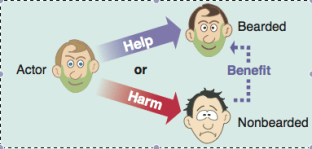
The “greenbeard” lets the players know who to help and who to hurt. Adapted from West and Gardner 2010, Altruism, spite, and greenbeards. Science 327:1341-1344

It’s easy to segregate yourself from hated rivals when you have a nice defining character. In evolutionary biology, we call that sort of thing a “greenbeard” for esoteric reasons. The general idea is that a recognizable “tell” that is invariably linked to a certain group of other, harder-to-detect traits can help similar individuals find each other in a crowd and give each other preferential treatment. Greenbeards are a principle trick for evolving social interactions and “altruism”.

So wearing a greenbeard helps cooperators keep the benefits of their cooperation for themselves by a) seeking each other out and b) excluding those beardless sonsofbitches who might want to take their stuff. I’m arguing here that, for the American fundamentalist Christian, disbelief in evolution acts as a greenbeard. It clearly and necessarily discourages admixture between Christians and everyone else.

The best greenbeards are cheap. An organism has to get more benefit from cooperation than it pays for its greenbeard to make growing the damn thing worthwhile.  Disbelief in evolution carries no benefit in itself. Indeed, it’s a “non-trait;” purely negatively defined. It isn’t a thing, it’s the absence of a thing. On the other hand, outside of professional science, it probably doesn’t carry much of an obvious cost, either: the ancient origins of mankind, and life in general, arguably don’t have much bearing on most people’s daily lives. The choice to believe or not believe in evolution, viewed in this manner, is therefore not a “living”, or important, choice. The 20th century American philosopher William James, in his essay “The Will to Believe”, wrote that a choice has to be “momentous” in order to be “living”, which is to say, for it to matter what choice one makes. By “momentous” he means that what is chosen must cause some significant effect on one’s life.

I think many people would accept this statement — that the phenomena putatively affected by evolution are distant and occupy a scale so vast as to exclude normal human experience. Given that, belief in evolution appears to be a nearly neutral trait, and in evolutionary terms it can be gained or lost at random in a population. Nearly-neutral traits are ripe targets for evolutionary innovation (for instance, neofunctionalization following gene duplication).  In this case, disbelief in evolution evolved into a greenbeard trait for Christians.

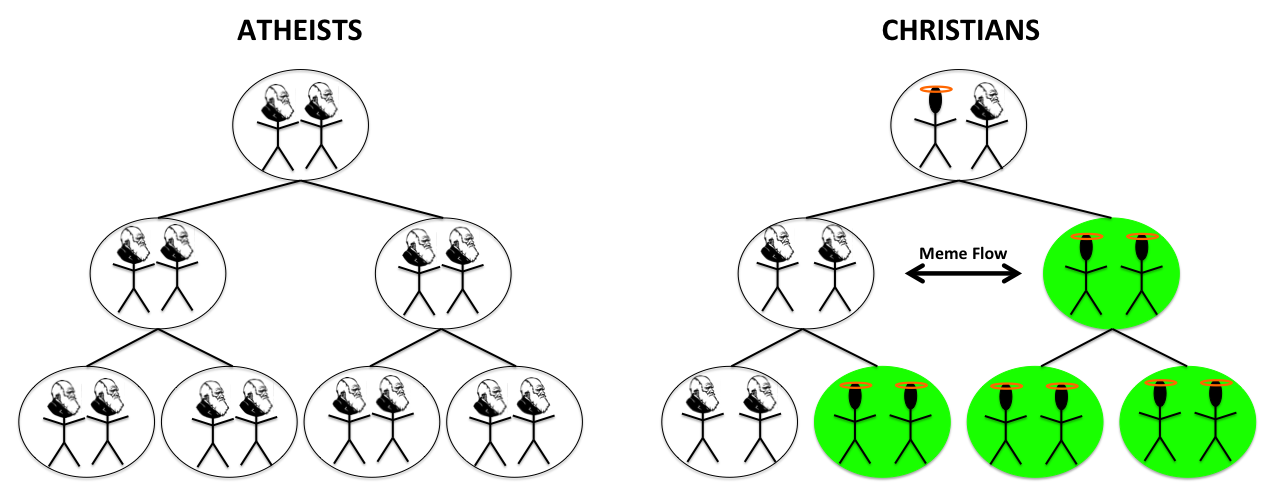
How did this happen? Let’s say we start with a population split between atheists, all of whom believe in evolution (having no competing beliefs about the origins of species), and Christians, who are mixed in their beliefs (see figure below, where Darwin-heads mean belief in evolution and halos indicate Creationists). Initially the belief trait is irrelevant, and amongst the Christians it expands and contracts by an apparently random process; however, at some point one group of Christians notices that they all disbelieve in evolution (possibly just by chance), and all of the non-Christians believe in it. Moreover, whereas Christians could in principle believe either in Creation or Evolution, atheists have no alternative belief: belief in creation is thus a permanent and specific barrier between the faithful and the profane. Displaying the greenbeard of disbelief in evolution unites Christians, helps them find each other, and separates them socially and genetically from non-Christians. Whereas the belief in evolution carries no cost or benefit in itself, the greenbeard provides a selective advantage for Christians, emphasizing the divide between them and the rest of the world, filling pews and making money. Perhaps more importantly, money and socialization help Christians have more sex with other Christians, thus making more Christians and simultaneously keeping filthy Evolutionist DNA out of the breeding pool.  Thus, disbelief spreads pseudo-genetically (by belief transmission from parents to children) and also “memetically” as Christian evolutionists see how successful disbelievers are and decide to change their belief status.

GreenBeardMeme

So there’s my case that disbelief in evolution is a greenbeard. I would also like to encourage you to think briefly about whether, in some cases, belief in evolution is a greenbeard. When scientists, and the scientifically literate, object to creationism, we do it because we understand the weight of evidence supporting evolution. I wonder, though, if perhaps there are pockets of people out there who believe in evolution not because they understand it, but because hated Christians don’t believe in it. A greenbeard for clueless college leftists, perhaps? Perhaps a similar dynamic holds for belief in climate change? If these “controversies” are in fact driven by fashionable greenbeards, it would present a bothersome problem for those of us who abhor the politicization of truth.

If disbelief in evolution doesn’t have anything to do with evolution, and everything to do with group identity, are scientists fighting the wrong enemy when they try to argue the scientific strengths of evolution against religious nay-sayers? I think they are, and will talk in my next post about how I think we should change our strategy in light of greenbeard-ism.

Why Don’t People Believe In Evolution? Part II: Pareto Optimization

The Antisocial Darwinist’s Mission

Posted by Jeff Morris on February 1, 2014
Posted in: Uncategorized. Tagged: evolution, social darwinism, sociobiology. Leave a comment

A century ago it was common for philosophers and scientists to apply evolutionary thinking to the great questions of human society.  Unfortunately, the notion of “survival of the fittest” (the only dynamic most people associate with evolutionary theory) was used to justify a number of questionable political practices.  In particular, the biological approach toward sociology became associated with the satanized Nazi party. After the global conniption fit that was World War II ended, all social thought grounded in anything like biology or evolutionary theory was swept up under the perjorative term “Social Darwinism” and pushed down the memory hole.  In my opinion, this was a gigantic mistake for two reasons:

  1. There has been great progress in our understanding of the evolution of social interactions in the non-human world over the last 60 years, and we now know that social interactions of all sorts can evolve without any form of conscious choice. Understanding how the rest of nature puts societies together could help us figure out which of our social structures should be strengthened and which are doomed to fail.
  2. Divorcing social philosophy from biological reality reinforces the absurd idea that humans aren’t subject to the laws governing the rest of life, and absolves thinkers from both the left and the right of the need to ground their philosophy and policy in the realm of biological reality as opposed to the cloud-cuckoo-land of their righteous imaginations.

Of course, I think our society’s decision to go down that route can be explained evolutionarily — I’m sure I’ll write about it at some point. It’s my goal with this blog to explore politics, economics, and culture from the perspective of evolutionary biology and hopefully inject some scientific logic into the rhetorical fever swamp that is the blogsophere. Also, I hope to show the world of “normal people” that not all scientists are deluded left wing academic apparatchiks.

That, and I’ll review underground music from time to time.

Posts navigation

Newer Entries →
  • Recent Posts

    • “Make Biology Great Again, Mr President” March 7, 2025
    • How to Rig an Election If You’re a Scientist February 9, 2023
    • Found: Nazi Flag in the US Capitol December 21, 2022
    • For Giving Tuesday, Support a Cancelled Professor November 29, 2022
    • The 20th Anniversary of Palindrome November 20, 2022
  • Enter your email address to follow this blog and receive notifications of new posts by email.

  • Subscribe Subscribed
    • The Antisocial Darwinist
    • Join 58 other subscribers
    • Already have a WordPress.com account? Log in now.
    • The Antisocial Darwinist
    • Subscribe Subscribed
    • Sign up
    • Log in
    • Report this content
    • View site in Reader
    • Manage subscriptions
    • Collapse this bar